

You have the portfolio. Years of completed projects, happy clients, maybe some recognition along the way. And when someone in your city searches for an architect right now, a competitor with half your experience shows up first and you do not.
That is an SEO for architects problem. Not a talent.
Most firms still run almost entirely on referrals. That worked for a long time. In 2026 it is not enough on its own. AI search has changed how clients find professionals. Google’s AI Overviews answer questions at the top of the page now — and only firms with real topical authority, optimized portfolios, and strong local presence get surfaced in those answers.
A beautiful website that loads slowly with no indexable text is invisible to Google. At Ecommerce Planners, we provide best SEO Services for architects who are serious about being found by clients already searching for what they do.
[Image 1: Professional architectural building exterior with subtle Google search overlay] Alt Text: SEO for architects 2026 strategy guideWhy Most Architecture Firms Struggle to Get Found Online
Look at almost any architecture firm website and the pattern repeats. Stunning photography. Heavy image files. Almost nothing a search engine can read or rank.
Poor website structure is usually the first problem. Navigation built for visual aesthetics rather than logical page hierarchy leaves Google confused about what the site covers. Crawlers get stuck in JavaScript menus and image-heavy layouts with no clear content signals pointing anywhere.
No local SEO means the firm is invisible for the searches that matter most. Someone in Denver searching “residential architect in Denver” should find a Denver firm on page one. No city-specific pages, no Google Business Profile, no local schema — that firm simply does not appear.
Thin portfolio pages are the biggest missed opportunity in architect SEO. A project page with four photos and one sentence has zero ranking potential. Google cannot read images. Without text there is nothing to rank.
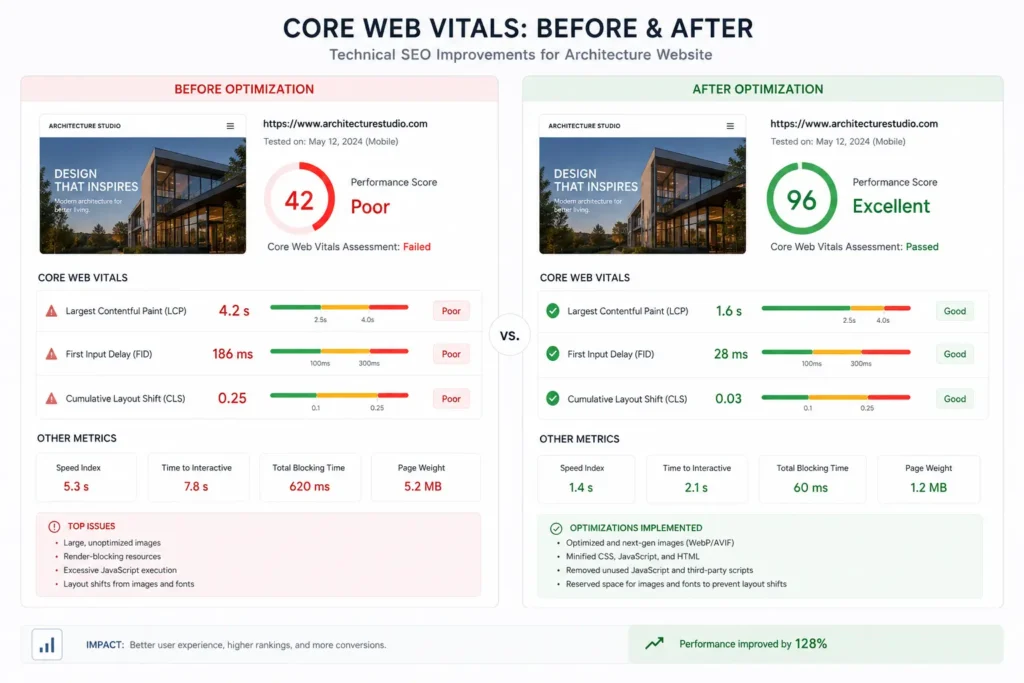
Slow websites from uncompressed architectural photography directly tank Core Web Vitals scores. That affects rankings—a confirmed factor, not a suggestion.
A real example. A residential architecture firm in Seattle. Strong portfolio. Beautiful website. Zero organic traffic. Their entire site had under 400 words of indexable text. Every project page was an image gallery — no descriptions, no alt text, no location context. Google had nothing to rank.
1. Focus on Local SEO Before Anything Else
Nobody searching for an architect searches globally. They type “architects near me” or “residential architect in Austin” or “commercial architect Dallas.” These are local intent keywords and the most valuable traffic an architecture firm near me search can deliver.
Local SEO for architects means being visible specifically in your geographic market. Google Maps is where most local clicks actually happen — the map pack appearing above regular results for any location-based search.
Create City-Specific Service Pages
A general residential architecture page does not rank for “residential architect in Austin.” You need a page specifically about residential architecture in Austin — mentioning the city, local building codes, regional styles, and neighborhoods you have actually worked in.
Serving multiple cities means one dedicated page per city. Each targeting its own local keywords. Each has content that cannot be copied and pasted to another city without a full rewrite.
Optimize NAP Consistency
Name, address, phone number — identical on your website, Google Business Profile, Apple Maps, Bing, and every architecture directory. Ave versus Avenue is enough inconsistency to suppress local rankings.
Add Local Schema and Embed Google Maps
LocalBusiness schema tells Google precisely where your firm operates. A Google Maps embed confirms physical presence. Both take under an hour and carry lasting ranking value.
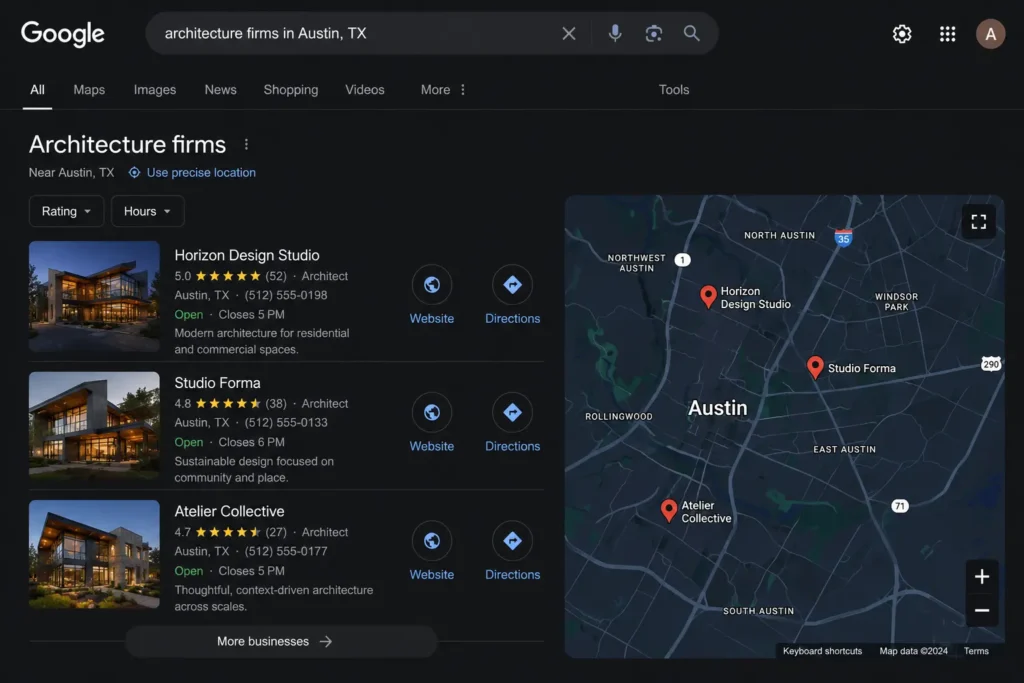
2. Optimize Your Google Business Profile Properly
Most firms have a GBP listing. Almost none have it properly completed. That gap is a direct opportunity.
A fully optimized architecture firm GBP needs: primary category set to Architect specifically, service descriptions written around what clients search, real project photos uploaded consistently, weekly posts on recent projects or firm news, responses to every review, a full services list covering all offerings, proactively seeded Q&A, correct service area, and accurate hours including holiday closures.
Reviews matter more than most firms realize. BrightLocal’s survey found 87% of consumers read online reviews before contacting a local business. For something as important as hiring an architect, review volume and recency often determine who gets the call — not portfolio quality, not website design. A simple system like sending clients a direct review link after project milestones or at handover builds this consistently with almost no ongoing effort and no awkward in-person ask.
3. Your Portfolio Is Your Biggest SEO Asset
This is where SEO for architects gets genuinely interesting and where most firms leave enormous ranking potential untouched.
Every completed project is a potential search landing page. A luxury home in Scottsdale could rank for “luxury home architect Scottsdale.” A commercial renovation in Chicago could rank for “commercial architect Chicago.” But only if the page is actually built to rank.
How to Optimize Architecture Project Pages
Each project page needs to work as a standalone SEO asset — not just a gallery.
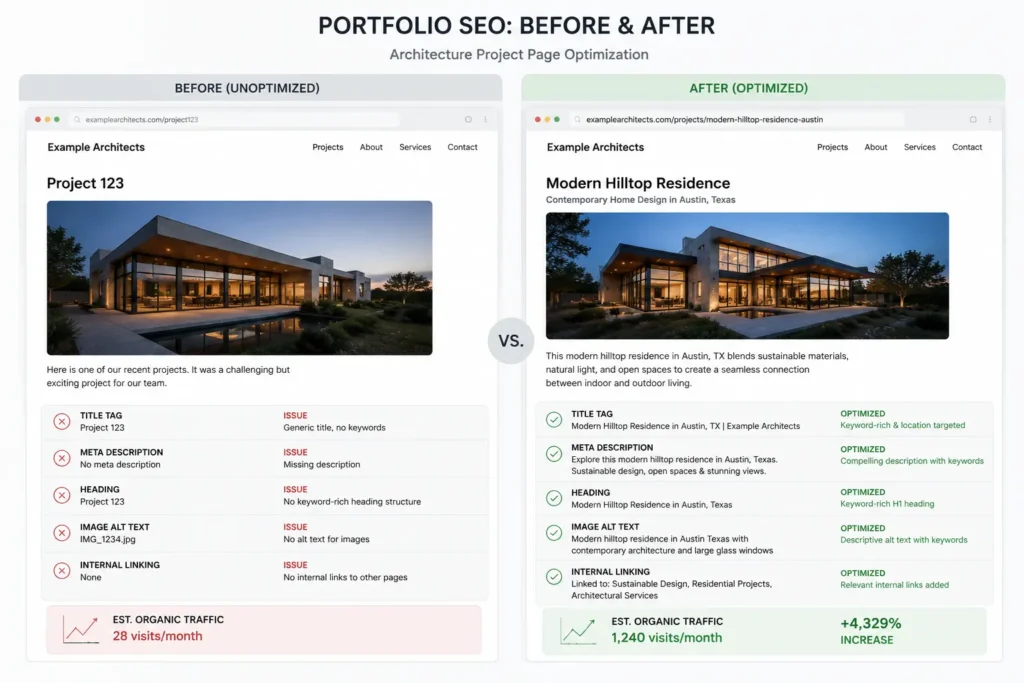
Title and H1 matter. “Modern Sustainable Home — Phoenix, AZ” tells Google what this page covers. “Project 47” tells nobody anything. Write a real description covering the design challenge, solution, materials, location, architectural style, and client goals. Three hundred words minimum. City name and style are woven naturally throughout. That is an architect’s portfolio SEO in practice.
Internal links from each project page to the relevant service page and related projects build relevance that strengthens the entire site.
Image SEO for Architects
Every image file should be named before uploading. modern-sustainable-home-phoenix-arizona.jpg tells Google what the image shows. IMG4872.jpg tells Google nothing.
Every image needs a descriptive alt tag. “Modern sustainable home design in Phoenix Arizona with passive solar features” — accurate, descriptive, naturally keyword-relevant.
Compress every image before uploading. Squoosh and Shortpixel cut file sizes by 60 to 80% with zero visible quality loss. Unoptimized architectural photography is the single most common reason architecture website SEO fails Core Web Vitals.
Why Thin Portfolio Pages Never Rank
Five photos and no text. Zero ranking potential. Search engines rank text signals — title tags, headings, body copy, alt text, schema. An image gallery with nothing else is invisible to Google no matter how good the photography is.
Every project page needs enough well-written content that Google understands what was built, where, for whom, and why it matters. Without that the page does not exist in search.
4. Target the Keywords Real Clients Actually Search
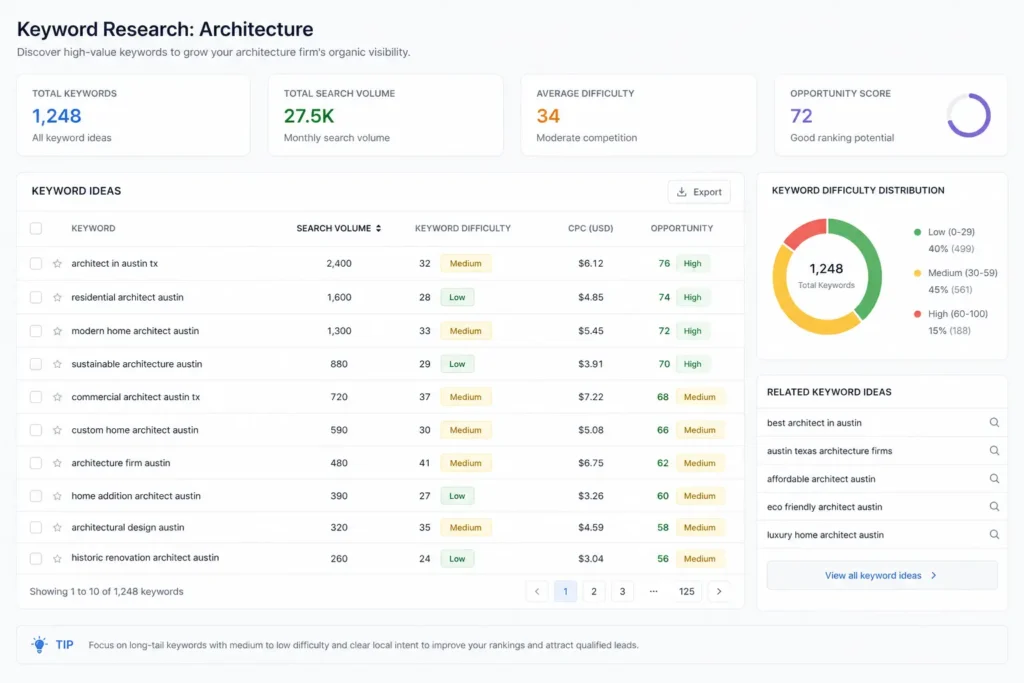
Most architecture firms aiming at keyword targeting focus on broad terms dominated by national directories with a fifteen-year domain authority. The real opportunity is in specific commercial intent keywords and local long-tail searches that are actually winnable.
| Keyword Type | Examples |
| Local commercial intent | luxury home architect in Denver, commercial architect near me |
| Service specific | sustainable architecture firm, modern home architect |
| Project type | kitchen addition architect, home extension architect |
| Informational | how much does an architect cost, do I need an architect for an extension |
| Style specific | mid-century modern architect, Scandinavian home design architect |
How to Find Architecture SEO Keywords
Start with Google itself. Type your primary service and read the autocomplete and People Also Ask. Those are real searches real clients are making right now.
Use Ahrefs, Semrush, or Ubersuggest. Filter keyword difficulty below 20 and search volume above 50. Map one primary keyword to each page before writing a single word. No two pages compete for the same term. That mapping process is the foundation of an architecture website SEO done right.
5. Create Service Pages Instead of Generic Website Pages
A single “Services” page listing everything the firm does is one of the weakest SEO structures possible. Too broad to rank for anything. Serves every keyword at once and ends up serving none effectively.
Google ranks focused pages. A page built entirely around residential architecture — real depth, project examples, clear keyword target — outranks a generic services page every time.
Rather than one catch all page, create individual pages for residential architecture, commercial architecture, interior architecture, sustainable design, luxury home design. Each targeting its own city-specific keyword. Each has unique content, project examples, and its own call to action.
Our website optimization services build exactly this kind of focused structure for professional firms.
6. Blogging Still Works for Architecture Firms
What works in 2026 has shifted. Generic design trend posts with no keyword targeting produce almost nothing. What works is content built around real search intent.
Educational blogs answer questions clients search for before they are ready to call. “How much does it cost to hire an architect in Austin?” “Do I need planning permission for a home extension in Texas?” These bring in research-phase traffic from people who will eventually hire someone.
Local project blogs document completed projects in specific neighborhoods — design challenges, local regulations, community context. These build city-level topical authority and rank for hyper-local searches that competitors ignore.
Design trend content covering the functional and structural reasoning behind passive solar design or mass timber construction demonstrates the expertise AI search systems are trained to reward.
Every post should link to the most relevant service page and at least one location page. That internal linking is how blog traffic translates into service page authority over time. Our content marketing services build this kind of structured editorial strategy for architecture and design firms.
7. Technical SEO Can Quietly Kill Rankings
Architecture sites are built for visual impact. Full-resolution photography, full-screen video headers, parallax effects, and custom fonts loading from external servers. Every element adds weight.
Why Architecture Websites Often Load Slowly
Google’s Core Web Vitals measure load speed, visual stability, and interactivity. A site taking six seconds to load on mobile fails all three. Google’s research shows 53% of mobile visitors leave a page taking more than three seconds to load. Clients are gone before they ever see the portfolio.
Pagenot crawable, JavaScript navigation, pages that are blocked in robots.txt, orphaned project pages with no internal links to or from in result are pages that Google cannot index and therefore cannot rank.
Mobile-first indexing means Google evaluates the mobile version first. Beautiful on desktop, awkward on mobile — Google judges the worst version.
Broken links signal neglect and drain authority from pages that need it. A quarterly audit catches these before they compound.
Our web design services build architecture websites that are visually outstanding and technically sound from day one.
8. AI Search Is Changing SEO for Architects
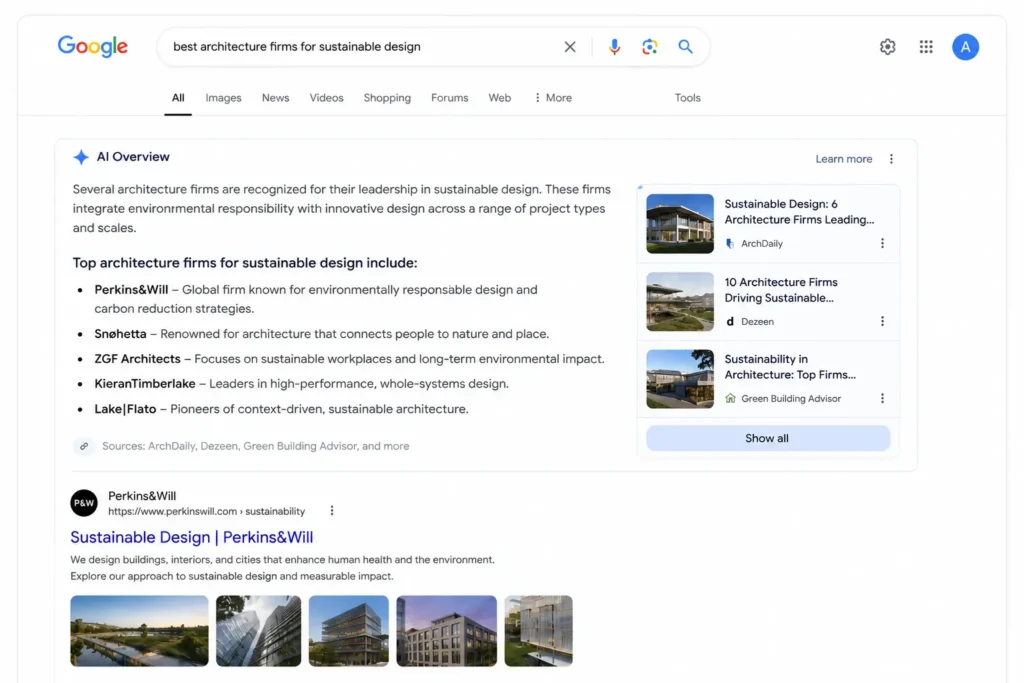
Google’s AI Overviews now appear at the top of many results — summarizing answers before the user clicks anything. For queries like “how to find an architect” or “what does an architect charge,” Google answers directly without requiring a visit to any website.
The threat is real. Informational content that used to drive consistent traffic now gets summarized by AI with no clicks sent. Blog posts serving only informational queries with no conversion path have lost significant traffic value.
The opportunity is bigger. AI Overviews pull from sources with demonstrated expertise, clear entity signals, and topical authority. Firms that publish consistently and have strong E-E-A-T signals — Experience, Expertise, Authoritativeness, Trustworthiness — get included in those answers. That positioning is more valuable than a standard ranking. It tells the searcher this firm is a trusted source.
Conversational search is growing because of ChatGPT and similar tools. “Who are the best sustainable architecture firms in Portland” is how people increasingly search. Content answering these queries with specific named expertise and real geographic context performs better in both AI and traditional search.
Generic content loses in AI search. Specific, authoritative, locationally grounded content from firms demonstrating real expertise wins. That is the direction 2026 is moving.
9. Backlinks Still Matter — But Relevance Matters More
One link from ArchDaily or a respected regional design publication outperforms fifty generic directory links. Quality over quantity is how the algorithm actually works now.
These directories Architecture | Houzz | Architizer | ArchDaily | Dezeen have real authority in the architecture niche. Local citations such as Chamber of Commerce, BBB, local directories help local SEO signals and you must have NAP across your entire network of sites and real estate platforms.
Media coverage and design publication features generate high-relevance links that no directory submission volume can replicate. Guest contributions to architecture publications build topical authority alongside backlinks simultaneously.
Avoid any service promising large backlink volumes fast. Spam links from irrelevant sites trigger Google’s spam detection filters and manual penalty recovery can take three to six months of painful work to undo. Our local SEO services handle citation building and link acquisition properly for professional service firms without shortcuts.
10. Most Architecture Websites Fail at Conversion Optimization
Everything else in this guide builds traffic. This is what happens when that traffic arrives — and why most architecture websites lose the inquiry before a contact is ever made.
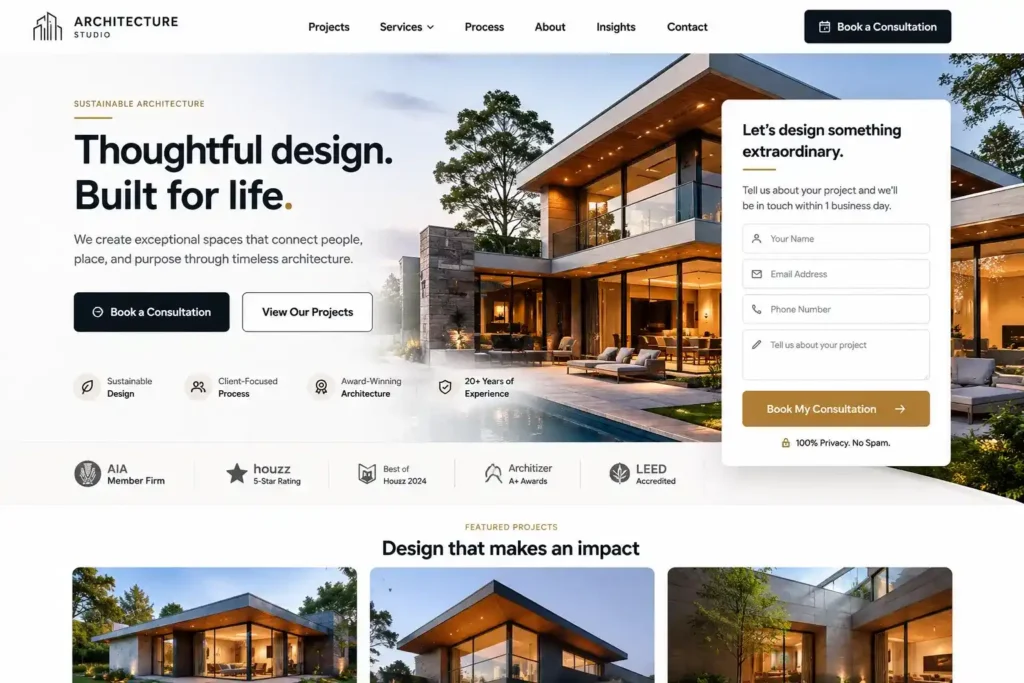
Weak CTAs are the most common problem. “Contact us” buried in a navigation menu is barely a suggestion. Each page needs a specific top action (schedule a free consultation, get a project estimate, view our residential portfolio), visible where someone will see it when ready to act.
Poorly designed bad inquiry forms requesting everything up front or that do not work with mobile platforms cause friction precisely when someone wants to reach out. Name, email, phone, and two project-specific questions qualify the lead. The rest happens on the call.
No trust signals leave prospective clients with open questions. Named architects with credentials. Awards and professional associations. Client testimonials with real names. Published project features.
No process explanation is something almost no architecture firm addresses. A simple “How We Work” section covering the discovery call, design proposal, planning phase, and project delivery removes uncertainty and meaningfully increases conversion rate.
Traffic that never converts is the most expensive outcome in digital marketing — you paid to get someone there and got nothing from it. Our Google Ads services and branding services are built around the full client journey from first search to booked consultation.
Common SEO Mistakes Architects Make
Image-only galleries with no descriptive text — Google cannot rank images. A portfolio with no descriptions is invisible no matter how exceptional the work.
Ignoring local SEO entirely — architecture is a local business and city-based searches produce the most qualified prospective clients.
No keyword targeting — beautiful copy with no search terms means nothing to search engines.
Duplicate project descriptions — same template across multiple pages triggers duplicate content issues suppressing the entire portfolio section.
Thin blog content — short posts with no keyword research produce no measurable SEO value.
Uncompressed images — failing Core Web Vitals is a fixable one-time problem with lasting ranking impact.
No content strategy — sporadic publishing with no keyword mapping never compounds into sustainable growth.
How Long Does SEO for Architects Take?
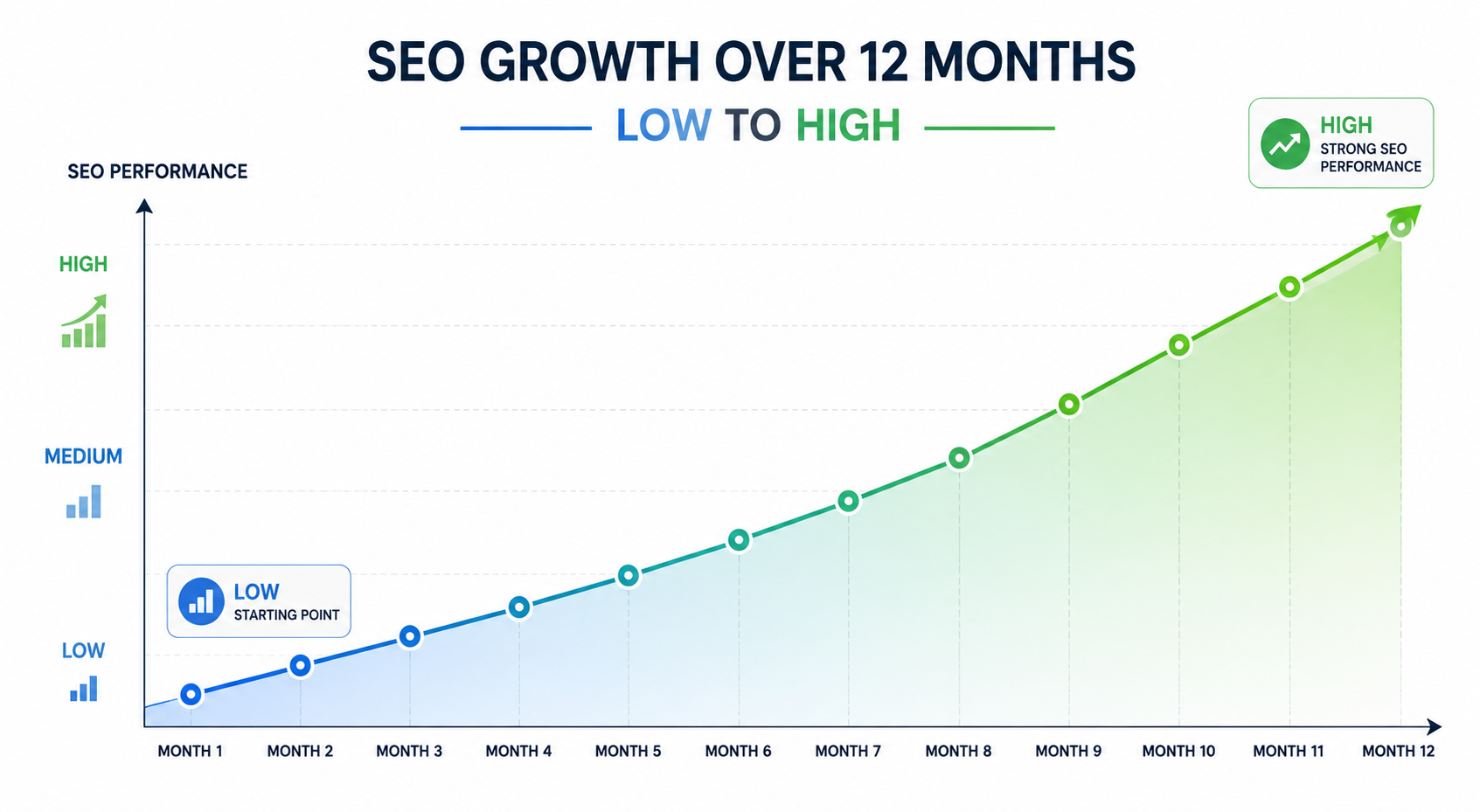
Months 1 to 3 — technical fixes, GBP optimization, local SEO setup, initial content publishing. Early traction in local pack rankings and long-tail positions possible in less competitive markets.
Months 4 to 6 — portfolio pages start gaining impressions. Service pages rank for secondary keywords. Map pack visibility improves as citations build.
Months 6 to 12 — authority compounds. Competitive keywords become reachable. Blog content drives consistent traffic alongside referral traffic from directories and publications.
The consistent pattern holds across every market and every niche within architecture — firms investing in SEO for architects and maintaining it consistently for twelve months always outperform competitors who do not. The compounding effect is slow at the start and accelerates at the end.
Final Thoughts
SEO for architects in 2026 is not a mystery. Build the right pages. Optimize the portfolio. Get local visibility in the cities you serve. Publish content demonstrating real expertise. Fix the technical problems suppressing the site. Stay consistent.
Most firms stop when early results look slow. The firms dominating organic search today started twelve to eighteen months ago and never stopped.
Your portfolio is an SEO asset that no other business type has in the same way. Location-specific, style-specific, project-specific content that can rank for exactly the searches ideal clients are making. That advantage belongs to firms that build and optimize those pages properly.
Architecture firms with strong SEO for architects strategies show up when someone in their city searches for what they offer. That visibility compounds into consistent inquiries month after month without paying for every click.
Contact Ecommerce Planners today for a custom SEO strategy built specifically for your architecture firm.
70% of potential clients kick off their search for an architectural firm on Google — and 75% never bother to scroll past page one, meaning an architecture firm not in the top ten results is effectively invisible to three quarters of its entire prospective client base.
Source: Comrade
FAQs
Q: Is SEO worth it for architects?
Yes. Referrals are unreliable long-term. SEO for architects brings consistent inbound leads from people already searching in your city. It compounds over time and firms that invest early build an edge competitors can’t easily close.
Q: How do architects rank on Google?
Service pages that are targeted, portfolio pages that are fully optimized = Google Business Profile that is complete, local citations that are consistent, quality backlinks, regular authority building content for each of your specific service areas and service locations.
Q: What’s the best marketing strategy for architects?
A portfolio-first website built for search and conversions. SEO for architects for long-term visibility. An optimized Google Business Profile for local rankings. Google Ads to fill the pipeline faster while organic growth builds in the background.
Q: How long does SEO take for architecture firms?
Three to six months for early local keyword traction. Six to twelve months for competitive rankings. Firms that commit to the full timeline consistently outperform those expecting quick results.
Q: Do architects need blogging?
Yes. Educational content attracts research-phase visitors. Local project posts build city-level authority. Genuinely useful content signals real expertise to Google’s AI systems rewarding documented knowledge over generic posts.
Q: What is local SEO for architects?
Getting your firm found when someone nearby searches for an architect. It covers Google Business Profile optimization, city-specific pages, consistent business information across directories, and location-relevant reviews. The highest-converting traffic most architecture firms can get.

