
Here is something most business owners figure out only after burning through two or three months of ad budget. The platform is not what determines results. Google Ads works — that part is settled. The question is whether the team managing your campaigns knows what they are doing or whether they are running the same generic structure on every client regardless of industry or goals. Poorly managed accounts do not just underperform. They actively waste money on searches that will never convert.
At Ecommerce Planners, we are the best Google Ads Management Services provider for businesses that need campaigns built around revenue outcomes — not click volume. Since 2019 we have managed accounts across dozens of industries and rebuilt hundreds of campaigns hemorrhaging budget through structural problems that should never have existed.
Transparency Disclaimer
This list was researched and written by the team at Ecommerce Planners. We placed ourselves at number one because we believe our approach to Google Ads management services delivers measurable results for the industries we serve. Every other agency was evaluated independently based on four criteria — industry specialization depth, reporting transparency, documented client results, and pricing clarity. No agency paid for inclusion. Our goal is an honest comparison that helps business owners decide — even when that decision is not us.
What Separates Real Google Ads Management From Basic Account Babysitting
Growth Versus Maintenance
There is a version of Google Ads campaign management where someone logs into your account a few times a week, checks that nothing has broken, and sends a monthly report showing impressions and click-through rate. That is maintenance. It keeps campaigns alive. It rarely makes them better.
Real management looks fundamentally different. Bid strategy testing against actual conversion data. Ad copy rotation with structured variant testing. Search term reports are reviewed weekly to expand negative keyword lists before irrelevant clicks drain budget. Landing page performance is analyzed alongside ad performance. Budget reallocated toward campaigns producing the lowest cost per lead.
According to Google’s internal data on certified partner performance, advertisers working with certified partners average 21% more conversions at equivalent budget levels. Small systematic improvements made every week produce dramatically different results at month six — and that compounding difference is the entire value proposition of professional Google Ads management services.
The Budget Waste Problem Most Agencies Ignore
WordStream’s analysis of over 2,000 Google Ads accounts found that 76% have significant budget waste driven by poor match type management and inadequate negative keyword maintenance. Three quarters of active accounts. That is not a fringe problem — it is the industry baseline.
Finding and eliminating that waste before adding more budget is typically the single highest-return action in any underperforming account. Every agency on this list was selected partly because they have systems for finding and fixing that waste rather than letting it run while charging management fees on top of it.
Evaluation Criteria Used for This List
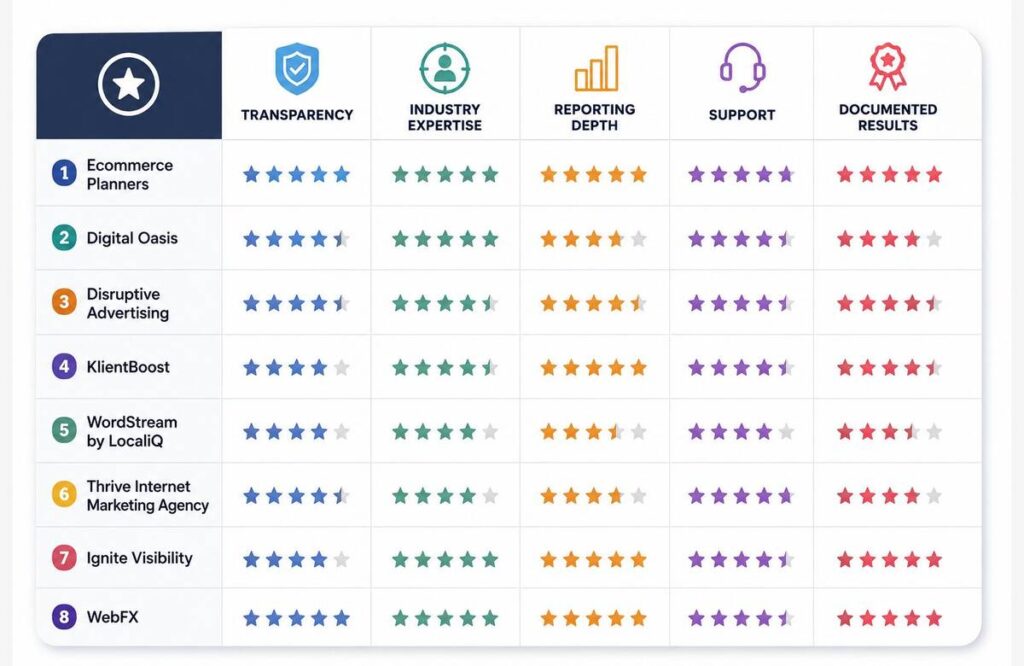
Four criteria shaped every placement on this list. Specialized experts in a field do better than broad-based experts in paid search for 12 months. Reports should show cost per lead and ROAS. They should not just show impressions. You need to show documented results with numbers, not just general claims. Pricing structure clarity — agencies that cannot explain pricing upfront tend to lack transparency in management too.
Top 8 Best Google Ads Management Services in 2026
1. Ecommerce Planners
Best for: Local service businesses, contractors, e-commerce brands, legal and financial services, and startups building paid search from scratch
Since 2019 the Ecommerce Planners team has built and managed Google Ads management services campaigns across industries that demand real precision — categories where a single poorly managed keyword can cost $50 to $100 per click and a well-structured restructure can transform a pipeline within 90 days.
Their campaigns are built industry-specific by design. Google Ads for roofing contractors are structured around storm-damage and emergency search behavior with call-focused ad formats matching how homeowners look for help urgently, Google Ads for law firms use practice-area specific ad groups where keyword intent precision directly controls lead quality and cost per acquisition. Google Ads for e-commerce accounts integrate Shopping campaigns, Performance Max, and dynamic remarketing into a unified full-funnel strategy rather than treating each campaign type as an isolated channel.
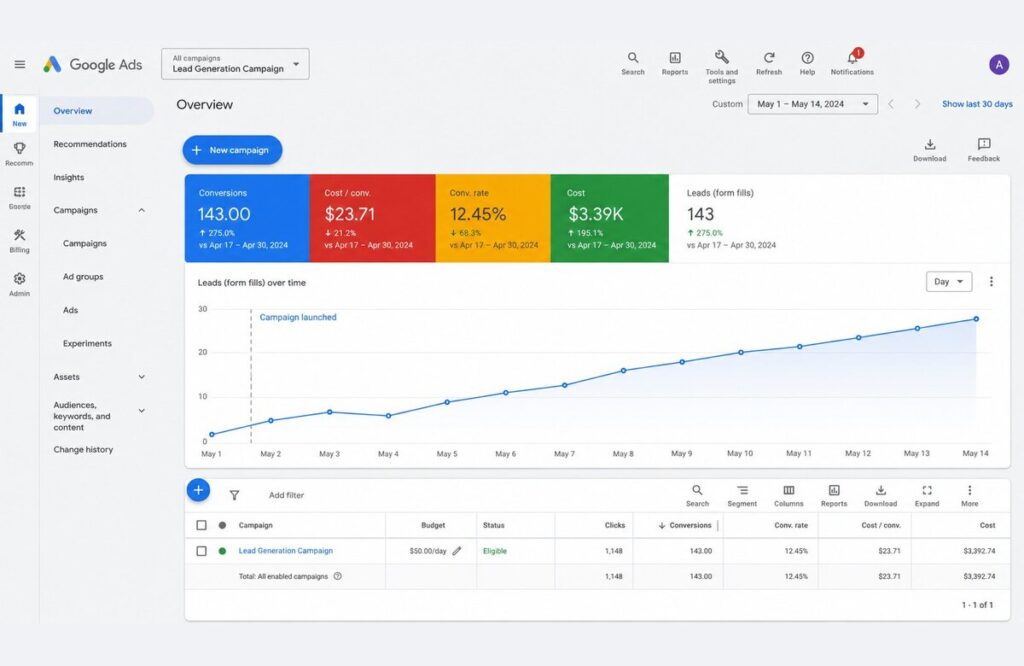
According to data from managed accounts, clients experience average reductions of 30 to 40% or more in cost per lead within the first 90 days, thanks to expanded use of negative keywords, match type restructuring, and bid strategy realignment toward actual conversion data.
Clients using Google Ads for contractors have reported ROAS increases (from 1.8x return on ad spend to 4.2x return on ad spend) within six months of a full account restructuring.
Monthly reporting includes spend, conversions, cost per lead, and optimizations made that month, with specific optimizations explained in plain language. Every account includes conversion tracking verification before launch — not optional, non-negotiable.
Pricing: Customized based on ad spend and campaign complexity. Free audit available before commitment.
Get a Free Google Ads Audit from Ecommerce Planners
2. Digital Oasis
Best for: Local service businesses in Houston and surrounding Texas markets needing a specialized local search partner with deep market-specific knowledge
Digital Oasis is a Houston-based agency with a deliberate and narrow focus on local service businesses. Not enterprise brands. Not national e-commerce. or SaaS. That singular focus is their primary differentiator in a field crowded with generalist agencies claiming to serve everyone equally well.
Where generalist agencies apply broad campaign templates to local accounts, Digital Oasis structures campaigns around specific search behavior patterns of local buyers — urgency triggers that drive immediate call behavior, neighborhood-level geographic targeting that prevents budget leaking into unserviceable areas, and call-focused ad formats that convert when someone needs help today.
Their Google Ads management services integrate paid search with Google Business Profile optimization simultaneously — a combination that matters because local map pack visibility and paid ad positions overlap in local results. A business appearing in both positions captures significantly more visibility than one competing in paid alone.
For businesses in high-competition Texas markets — covered in our Google ad agency in Texas guide — Digital Oasis brings market-specific knowledge that a nationally positioned agency simply cannot replicate.
Pricing: Customized based on business size and campaign scope. Free account audit available before commitment.
Visit Digital Oasis
3. Disruptive Advertising
Best for: Mid-market businesses spending $10,000 or more monthly needing rigorous data analysis and systematic waste elimination
Disruptive built their reputation around a specific insight backed by published research — the majority of Google Ads management accounts waste significant budget through structural problems that are identifiable and fixable through methodical analysis. Their audit methodology goes deeper than most agencies because it requires honestly acknowledging what previous management missed.
Their core strength is funnel-level analysis connecting campaign performance to actual revenue outcomes rather than stopping at lead volume. For businesses where lead quality varies significantly — a law firm where one case generates $50,000 or a SaaS company where one enterprise customer is worth $30,000 annually — revenue-level optimization changes which keywords and landing page experiences get prioritized in ways that surface-level management misses entirely.
Pricing: Typically 15 to 20% of monthly ad spend. Makes most financial sense for businesses already spending $10,000 or more monthly.
4. KlientBoost
Best for: SaaS companies, B2B lead generation businesses, and brands where landing page conversion rate is a measurable bottleneck
KlientBoost made a deliberate decision that separates them from most Google Ads management agencies — they refuse to treat paid search management and landing page optimization as separate offerings. Every engagement includes both disciplines because ad performance and post-click performance are not independent variables.
Their landing page testing methodology runs structured multi-variant experiments rather than simple A/B tests — producing more robust conclusions about what drives conversion behavior. Case studies from KlientBoost showcase that through the use of both PPC and CRO, they have been able to show a B2B client a 300 to 400% increase in qualified lead volume. It just goes to show how much more leverage you get from using both rather than just one.
Pricing: Higher entry point reflecting the dual scope of PPC plus CRO. Best evaluated as a combined investment rather than comparing the fee to a PPC-only alternative.
5. WordStream by LocaliQ
Best for: Small businesses wanting more structure than pure self-management but not ready for full-service agency outsourcing
WordStream occupies a distinct position in the Google Ads management services landscape — part software platform, part managed services provider, part educational resource. For small business owners who want more control than fully outsourced management provides but lack the expertise to self-manage effectively, that hybrid positioning addresses a real gap.
Their free Google Ads Performance Grader grades existing accounts across ten dimensions including wasted spend, quality score, and impression share — producing specific actionable recommendations used by millions of advertisers to identify quick wins. Their managed services team handles straightforward local and small business campaigns effectively. Complex multi-channel accounts benefit from more specialized depth.
Pricing: Software subscriptions start around $49 per month. Managed services scale with account complexity and spend level.
6. Thrive Internet Marketing Agency
Best for: Small to mid-size local businesses wanting Google Ads managed alongside SEO, social media, and web design through one integrated relationship
Thrive’s core value is channel integration. For local business owners managing three or four separate specialist agencies, the operational overhead of coordinating strategy and reporting consumes meaningful time. It creates gaps where channels work against each other.
Having one team manage paid search, organic search, social, and web with a shared understanding of business goals removes that friction. Campaign learnings from Google Ads campaign management inform SEO strategy. Landing pages built for paid traffic are designed with organic conversion in mind. Client reviews consistently highlight communication responsiveness — which matters when a campaign issue needs addressing quickly.
Pricing: Management fees start around $500 per month. Published transparently on their website.
7. Ignite Visibility
Best for: Big brands and businesses with lots of locations that are managing complex campaigns across more than one channel and/or market at the same time
Ignite Visibility works on a depth of team that most agencies simply aren’t able to build because they don’t have a client base big enough to keep specialists assigned to every major digital channel busy. Their paid media team gives enterprise accounts genuine senior specialist attention rather than the junior account manager hand-off that happens at most agencies after onboarding.
They publish an annual digital marketing forecast report widely cited across the industry — reflecting original research rather than synthesized conventional wisdom. If you’re a business that’s running campaigns in more than one place or across several different global markets at once, Ignite’s ability to handle that complexity without letting the quality fall off a cliff is a true differentiator.
Pricing: Enterprise-oriented. Best suited for businesses spending $25,000 or more monthly.
8. WebFX
Best for: Mid-market to enterprise businesses needing proprietary technology connecting ad spend to pipeline revenue with verifiable performance documentation
WebFX built MarketingCloudFX — their proprietary reporting platform — to solve the disconnect between Google Ads management dashboard metrics and actual business revenue. The platform integrates data across paid search, organic, and CRM systems to show how spend flows through to closed revenue rather than stopping at conversion counts.
For sales-driven businesses where the gap between a lead and closed deal involves multiple touchpoints and a weeks-long sales cycle, that revenue-level visibility changes how campaigns are optimized. A campaign generating fewer but higher-quality leads that close at higher rates looks worse in standard reporting and better in revenue-connected reporting.
WebFX has published documented results showing over $6 billion in tracked revenue driven for clients over five years — verifiable credibility at scale that most agencies cannot match.
Pricing: Custom pricing. Their website publishes ranges rather than gating everything behind a sales process.
How to Choose the Right Google Ads Management Service
Match the Agency to Your Industry First
Industry fit outweighs agency size, award history, and client roster in predicting actual campaign performance. A Google Ads management agency that built fifty successful SaaS campaigns will approach a local plumbing business with assumptions that actively hurt performance — national targeting frameworks applied to a 30-mile radius, landing page structures built for demo requests applied to service calls, bid strategies calibrated for month-long sales cycles applied to a 24-hour conversion window.
Ask three questions before signing. How many clients in your exact industry are they actively managing? What does a typical campaign structure look like at your spend level? What cost per lead and ROAS outcomes have they produced for comparable clients — and can they provide references?
Understand What the Pricing Model Incentivizes
The percentage of ad spend pricing creates an incentive misalignment that most owners never consider. A 15% fee on a $5,000 spend is $750. On $10,000, it is $1,500. The agency doubles revenue when the budget doubles — regardless of whether the increase is justified by performance data. Flat fees remove that incentive. Performance-based models align incentives with outcomes but require clean tracking and agreed-upon measurement definitions. The right question is which structure aligns with what you actually want — more leads at lower cost.
Is Your Current Budget Working as Hard as It Should
Most accounts we audit have 30 to 50% of spend going to searches that will never produce a customer. That comes from actual search term reports — not an estimate. The waste is findable and fixable. Book a free Google Ads audit with Ecommerce Planners — we review your actual account, identify where budget is wasted, and show you what a restructured campaign could realistically deliver. No sales pressure. No generic software report. A real review from a team doing this since 2019.
What the First 90 Days of Proper Management Look Like
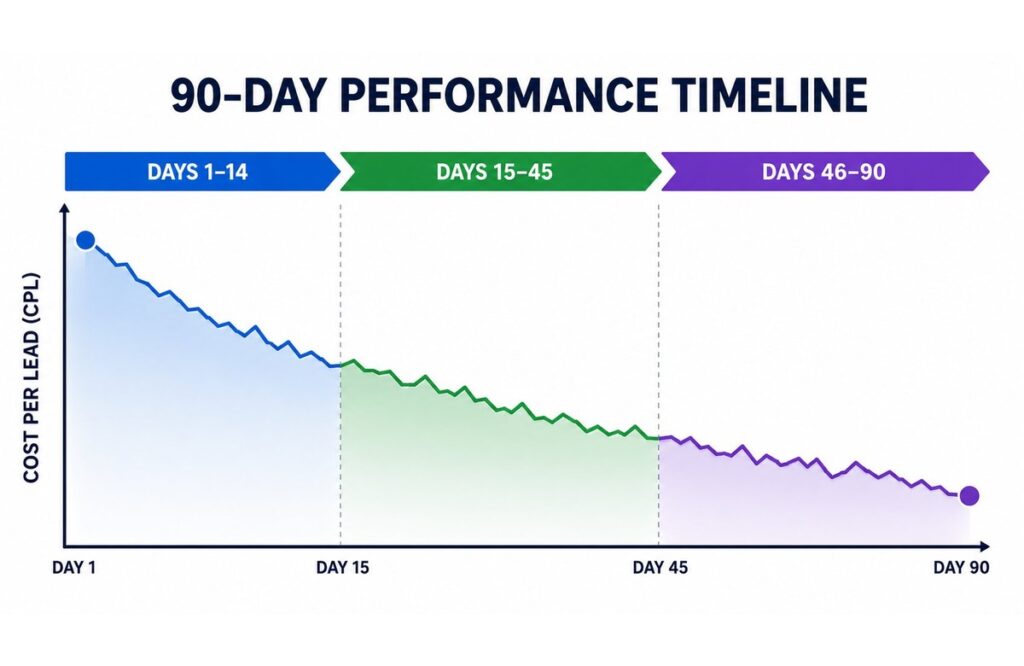
From Days 1 to 14 cover foundation — campaign structure audited or rebuilt, conversion tracking verified before spend goes live, keywords mapped with deliberate match types, and bids set conservatively to gather clean data.
Days 15 to 45 cover the first optimization cycle — search terms report mined weekly for negative keyword additions, bids adjusted based on actual conversion data, first ad copy variants deployed for testing.
Days 46 to 90 cover scaling what works — budget reallocated toward the lowest cost per lead campaigns, smart bidding activated once the 50-conversion threshold Google recommends is met, landing page recommendations made based on conversion rate data by source.
A properly managed account shows measurable cost per lead improvement by day 90. Across accounts from Google Ads for financial advisors to Google Ads for auto repair shops — rebuilt accounts consistently show 25 to 45% cost per lead improvement within the first 90 days.
Quick Reference Comparison Table
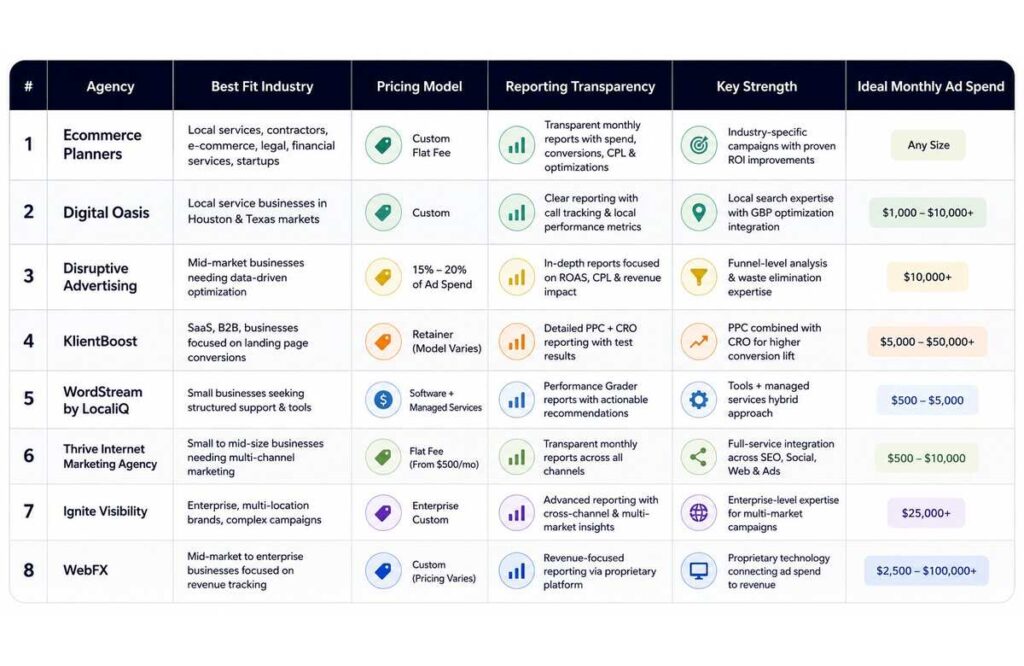
| Agency | Best For | Pricing Model | Key Strength | Ideal Spend |
| Ecommerce Planners | Local services, e-commerce, contractors | Flat custom fee | Industry-specific campaigns | Any size |
| Digital Oasis | Houston local service businesses | Custom | Local search and GBP integration | Small to mid |
| Disruptive Advertising | Mid-market data-driven optimization | % of spend 15-20% | Waste elimination and funnel analysis | $10k+ monthly |
| KlientBoost | SaaS and B2B lead generation | Retainer | PPC combined with CRO | Mid to high |
| WordStream | Small business self-managed support | Software plus managed | Performance grading tools | Low to mid |
| Thrive | Local multi-channel businesses | Flat from $500 | Full service channel integration | Small to mid |
| Ignite Visibility | Enterprise multi-location brands | Enterprise custom | Complex multi-market management | $25k+ monthly |
| WebFX | Revenue-tracking focused businesses | Custom | Proprietary revenue attribution | Mid to enterprise |
Final Thought
The eight Google Ads management services on this list represent genuine quality across different business sizes, industries, and budget levels. None is right for every situation. The decision comes down to industry fit, pricing model alignment, and the management depth your account requires. For local service businesses, contractors, e-commerce brands, and businesses building paid search from zero — Ecommerce Planners delivers industry-specific expertise and transparent reporting that turns Google Ads from a cost center into a predictable revenue channel. The best time to fix a poorly managed account was six months ago. The next best time is before another month of budget leaves without the results it should produce.
Get Your Free Google Ads Audit — Find out exactly what your campaigns need to perform in 2026. Honest answers. No commitment. From a team that has been doing this since 2019.
Google’s ad spending grew by 9% year-over-year in Q1 2025, driven more by rising costs than increased traffic volume — meaning advertisers are paying more for essentially the same number of clicks, putting extra pressure on campaigns to perform efficiently.
Source: North Country Consulting
FAQs
Q1. How much does Google Ads management cost?
The majority of top-tier Google Ads management offerings typically cost in the range of $500 to $2,500 per month for small and mid-sized companies. The ad spend charge for larger agencies is usually between 15 and 20 percent. When comparing prices, consider results: $1,000 per month to reduce lead costs by 35% will pay off in 60 days.
Q2. Is it worth hiring someone to manage Google Ads?
For most businesses in competitive industries yes. WordStream found 76% of accounts have significant budget waste from match type and targeting problems. A qualified manager eliminates that waste while improving conversion rates. For businesses spending $1,500 or more monthly, professional management typically pays for itself within 90 days.
Q3. What does a Google Ads manager actually do every month?
Weekly evaluation of search term reports, growth of negative keywords, modification of bid strategy based on conversion data, testing of ad copy variants, budget redistribution to top performers, and monthly analysis of cost per lead and ROAS are some of the optimization tactics used. The continuous weekly optimization work, not the initial setup, is what distinguishes strong management from average management..
Q4. How do I evaluate a Google Ads agency before signing?
If there are case studies for your business, request them. Both the cost per lead and the ROAS should be displayed. Check that before the spend goes live, conversion tracking is configured. Comprehend the price structure and any incentives it may include. Find out in detail how often they examine search term reports. Agencies that can’t give an answer to that query are failing to stop pointless spending.

