
Your clients keep asking the same question. Can you run our Google Ads too? And you want to say yes. The problem is you sell SEO, or websites, or social — not paid search, and you don’t have a media buyer on staff. Say no and they go shopping for a full-service shop that might walk off with the rest of the account. Say yes without the right skills and you torch the campaign along with their trust. This is the exact gap white label Google Ads management fills. An outside PPC team runs the campaigns for your clients while everything carries your brand. You stay the face. They stay invisible. That’s the model Ecommerce Planners is built to deliver for agencies.
Building this in-house is slow and expensive. A senior PPC hire means salary, tools, training, and months before they earn their keep. Few growing agencies can justify that for a handful of paid search clients. Renting the expertise makes more sense.
Here’s what this guide covers: what the service actually includes, why agencies outsource it, how pricing and margins work, the workflow from onboarding to reporting, how to vet a partner, and the mistakes to avoid before you sign anyone.
Understanding White Label Google Ads Management
White label Google Ads management means an outside PPC team runs the paid search campaigns for your agency’s clients, and all of it happens under your name. Your agency keeps the relationship. The client talks to you, opens reports with your logo, and never meets the people doing the optimization. The partner stays hidden on purpose.
Why does this model exist? Because plenty of agencies sell marketing without housing every skill in-house. An SEO shop knows organic search but may not live in Google Ads. A web design studio builds great sites yet has no media buyer. Social and local marketing agencies hit the same wall. White label fulfillment lets all of them say yes to paid search without rushing to hire.
The businesses served this way cover most local and small-business categories — service providers, ecommerce stores, professional practices. You own the strategy and the client. The partner owns the execution.

How the White Label Model Works
The structure is simple once it’s spelled out. A client hires your agency because they trust you. You offer Google Ads as part of your menu and close the deal. The white label partner takes over the campaign work — setup, optimization, tracking, the daily grind. When it’s time for an update, you hand the client the progress and reports as your own. Four steps. Clean handoffs. One brand out front.
Difference Between White Label PPC and Regular Outsourcing
Regular outsourcing is usually visible. The client knows a third party is involved and sometimes deals with them directly. White label outsourcing hides the partner completely. Reports, emails, deliverables — all of it wears your name. That gap matters, because white label PPC is built for agencies that want to resell the service as theirs, not just borrow a freelancer for one job.
Why Agencies Outsource PPC Fulfillment
Running Google Ads well is a daily job. It needs constant optimization, tight tracking, search term reviews, and reporting that survives client scrutiny. For an agency whose strength sits elsewhere, building that from scratch rarely pays off. Outsourcing lets you add paid search as a revenue stream without standing up a whole department.
There’s a focus angle too. With campaign work parked at a partner, your team spends its hours on what grows the agency — selling, strategy, client communication, retention. More clients, no extra internal load.
Expanding Services Without Hiring In-House
A skilled Google Ads manager is a serious cost. Salary is just the opening line. Add recruiting, onboarding, ongoing training to track platform changes, and the software a good media buyer expects. Then wait months for them to ramp. For an agency with a modest PPC roster, the math is rough. A white label partner already carries that overhead, spread across many agencies, so you rent the skill instead of buying it.
Increasing Monthly Recurring Revenue
Paid search renews by nature. Campaigns need management every month, so the fee lands every month. Fold PPC into your offering and you build a predictable revenue line that keeps coming as long as clients stay happy. That recurring base is what makes an agency steadier and worth more — and you get it without adding headcount.
Protecting Client Relationships
Here’s the quiet danger of not offering PPC. A client who wants paid search and can’t get it from you will find someone who provides it. Often that’s a full-service rival glad to take the rest of the work too. Offering Google Ads, even through a partner, shuts that door and keeps the relationship whole.
Core Services Included in White Label PPC Management
A real engagement covers the full life of an account, not a quick setup and goodbye. Here’s what the client actually gets.
Account Audit and Strategy Planning
Everything opens with a hard look at the current state. The partner reviews existing campaigns, checks how the budget is spent, and hunts for wasted spend hiding in broad keywords or loose targeting. A keyword and search term analysis shows what’s really triggering ads. They confirm whether conversion tracking records the right actions and study the competition. The output is a plan, not a guess.
Campaign Setup and Restructuring
With the plan set, the partner builds or rebuilds the account properly. That usually means search campaigns for high-intent queries, brand campaigns to defend the client’s own name, and competitor campaigns where they fit. Performance Max gets used when it suits the account, not by default. Remarketing pulls back people who already showed interest. Everything is organized around location-based structure and service-based ad groups so spend flows where it should.
Keyword Research and Match Type Planning
Keywords decide where the money goes. The partner finds high-intent and commercial terms that signal someone ready to act, adds local keywords for service-area businesses, and maps a deliberate match type strategy across phrase, exact, and broad. The negative keyword plan matters just as much — it blocks the irrelevant searches that drain the budget quietly. Done right, this is the line between qualified traffic and noise.
Ad Copywriting and Asset Optimization
Good copy lifts click-through rate and lowers cost. The partner writes responsive search ads with service-based and offer-focused headlines that match what people are searching for. Then come the assets that make ads bigger and more useful: call extensions so people can dial straight from the ad, sitelinks to key pages, callouts for selling points, and structured snippets that lay out services. Together they boost visibility and quality.
Conversion Tracking and Performance Reporting
None of it counts if you can’t measure it. The partner sets up call and form tracking so every lead registers, configures GA4 and Google Tag Manager correctly, and wires in CRM tracking where the client’s systems allow. On top sits branded reporting — clean, agency-labeled reports you hand over as your own work. Accurate measurement is the backbone of the whole service.
How Expert PPC Management Improves Campaign Performance
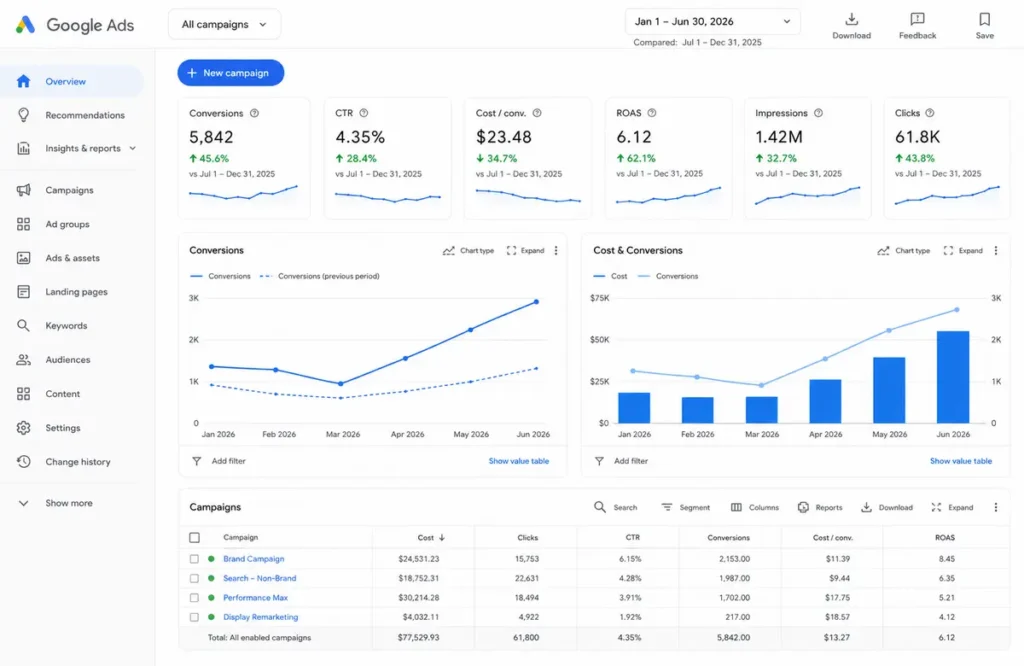
Skilled management doesn’t just keep an account alive. It makes it better, month after month. Sharper targeting trims the wasted clicks DIY accounts bleed on. Tighter keyword control raises traffic quality. Stronger copy lifts click-through rate, which improves quality scores and pulls costs down. Tracking shows which campaigns produce real results and which only look busy. Search term reviews push lead quality up. Budget shifts toward the winners. Landing page feedback can raise conversion rate without touching the ad account. And steady testing grinds cost per acquisition down while ROAS climbs.
Reducing Wasted Ad Spend
Underperforming accounts leak money in predictable ways. Loose keywords pull searches that never convert. Broad targeting reaches the wrong people. A thin negative list lets junk clicks through. A specialist tightens all three, so the budget stops draining and starts working — often more leads from the same spend.
Improving Lead Quality
Volume means nothing if the leads are junk. Better alignment between search intent and the landing page brings in people who actually need the service. When the keyword, the ad, and the page tell one story, the inquiries arrive warmer and closer to buying. That’s the result clients notice and stay for.
Making Decisions With Accurate Data
Tracking turns guesswork into evidence. Instead of hoping a campaign works, you see exactly what drives calls, forms, and sales conversations. That clarity guides every move — where to add budget, what to pause, which message wins. Without it, every choice is a coin flip wearing a strategy costume.
The Agency Workflow From Onboarding to Reporting
A solid partner runs on a repeatable process, so you always know the next step. Here’s how the relationship usually moves.
Client Intake and Access Setup
It starts with the essentials. The partner needs the client’s goals, monthly budget, service area, and which services to push. They review the landing page traffic will hit. Then the access pieces: Google Ads, analytics, and tracking. Nothing launches until the foundation is set and everyone sees the same numbers.
Strategy Approval Before Launch
Before a dollar goes live, you sign off. That covers campaign direction, the offer, keyword themes, the budget split, the tracking plan, and a launch timeline. This step protects everyone. The client knows what’s coming, and you’re never blindsided by what the partner builds.
Launch Monitoring
The first week needs close eyes. The partner watches for ad approval issues that stall delivery, checks budget pacing, and reviews early search terms to catch waste fast. They confirm tracking fires correctly and take a first read on lead quality. Catching small problems early keeps them from turning expensive.
Monthly Review and Client-Ready Reporting
Each month closes with a summary built for the client. It covers spend, leads, cost per acquisition, top campaigns, any issues found, and next month’s actions. Because the report carries your branding, you present it as your agency’s work. The client sees a clear story of progress, and you stay the trusted advisor.
Pricing, Profit Margins, and Resale Models
Pricing is where white label PPC turns into a real business decision. It can be billed as a flat monthly fee, a percentage of ad spend, a setup fee plus monthly management, or a hybrid. What you pay depends on account size, number of campaigns, tracking needs, reporting depth, and support level.
Agencies then resell with a markup. The trick is to price on value, not the cheapest number available. Bargain PPC tends to produce weak results, and weak results bring churn that costs far more than the few dollars saved. Charge for the outcome and the margin follows.
Common White Label PPC Pricing Models
Four models show up most. A flat monthly fee gives both sides predictability and resells easily. A percentage of ad spend scales the fee as the client grows, which fits larger accounts. A setup fee plus monthly management splits the heavy upfront build from ongoing work. A hybrid — base fee plus a small percentage — balances stability with room to grow, which is why many established setups use it.
How Agencies Build Profit Margins
The math is plain. Say the partner charges you $500 a month to manage an account. You resell it to your client for $900 to $1,200 a month, wrapped in your brand, your reporting, your relationship. The partner handles fulfillment. You keep the spread. Run that across a roster and paid search becomes a real recurring profit center with zero new hires.
How to Evaluate a White Label Google Ads Partner
Not every provider deserves your clients. Use these checks to tell a real partner from a risky one.
PPC Experience in Your Client’s Industry
Strategy isn’t one-size-fits-all. Local service businesses live on call volume and service-area targeting. Ecommerce needs Shopping campaigns and feed work. B2B runs longer sales cycles with different intent. A partner who has worked your client’s space already knows the buyer, the realistic cost per lead, and the traps. Ask for relevant experience, not just a portfolio.
Strong Tracking and Analytics Knowledge
Tracking is the foundation, so test it hard. A capable partner is fluent in GA4 and Google Tag Manager, runs call and form tracking as standard, and can handle CRM attribution when the client’s systems support it. Vague answers about measuring conversions are a warning you can’t ignore.
Transparent Communication
Your brand sits on their work, so you need to know what’s being done and why. A good partner explains decisions in plain language and keeps you in the loop without being chased. Silence and jargon are both red flags. The setup only works when you can answer your client’s questions with confidence.
Quality of Reporting
You present the reports as your own, so they’d better hold up. Look for spend, leads, conversions, cost per acquisition, click-through rate, search terms, lead quality notes, and clear next actions. A report listing only clicks and impressions hides more than it shows. Report depth signals work depth.
White Label Reliability
True white label means the partner respects your brand and stays behind the scenes. No contacting your clients directly unless you approve it, and everything they produce wears your identity, not theirs. One unapproved client email can undo a lot of trust.

Risks Agencies Should Avoid Before Outsourcing PPC
Outsourcing PPC is smart, but only if you dodge the usual traps. The biggest is chasing the cheapest provider, which trades short-term savings for long-term churn. Next is selling paid search before you understand the client’s real budget, which sets up expectations no campaign can meet. Skip conversion tracking and you’re flying blind. Send reports you never read and you look careless the second a client asks a question.
A few more. Promising instant results backfires; paid search needs testing time to settle. Forcing one campaign structure on every client ignores that industries behave differently. Skipping the expectation-setting around that testing window breeds frustration. And never checking lead quality with the client lets problems hide until they’re costly.
Poor Tracking Creates Poor Decisions
This one earns its own warning. Without accurate tracking, you can’t tell a winner from a loser. You might cut the campaign quietly producing your best leads and feed one that only looks active. Every decision built on broken data is a gamble, and those gambles cost the client money and cost you the account.
Weak Communication Can Damage Client Trust
Clients judge your agency by how informed and responsive you seem. Late updates and murky reports make you look unprofessional even when campaigns are fine. Slow communication from your partner becomes your problem, because the client only sees your brand. Set the standard early and hold them to it.
Final Thought
White label Google Ads management lets your agency offer paid search without building a team from scratch. It brings proper structure, accurate tracking, steady optimization, and client-ready reporting under your own brand. The right partner helps you scale, protect the relationships you fought to win, and deliver PPC that performs. Choose carefully — weigh expertise, transparency, tracking knowledge, and reliability before you commit. Ready to offer Google Ads under your brand? Contact us or Book Appointment about white label PPC built for agencies.
Google confirms that Performance Max campaigns run across all Google channels — Search, Display, YouTube, Gmail, Discover, and Maps — using asset groups and automation to optimize toward conversion goals, requiring strong conversion tracking and audience signals to perform effectively.
Source: Google Ads
White Label Google Ads Management FAQs
Who needs white label PPC management?
Mostly agencies that sell marketing but have no dedicated paid search team — SEO agencies, web design agencies, social media agencies, local marketing agencies, and independent consultants who want to offer Google Ads without an in-house hire.
How much does white label Google Ads management cost?
It depends on account size, monthly ad spend, how many campaign types are involved, and the level of support and reporting needed. Models range from flat monthly fees to a percentage of ad spend or a hybrid, so the right number shifts by client.
Will clients know I use a white label partner?
In a true white label setup, no. The partner works entirely behind your brand. Reports, emails, and deliverables carry your agency’s name, and they don’t contact your clients directly unless you approve it.
What services are usually included?
A full engagement covers an account audit, campaign setup and restructuring, keyword research, ad copywriting, conversion tracking, ongoing optimization, and branded monthly reporting — the whole life of a paid search account, from strategy to results.
Can white label PPC improve client retention?
Yes, when it’s done right. Well-managed campaigns, clear reporting, and better lead quality give clients a reason to stay. It also keeps them from leaving for a full-service competitor just to get paid search you could already provide.
Is white label PPC better than hiring in-house?
For most agencies, yes — faster delivery, far less overhead than a full PPC department. In-house can win for larger agencies with steady, high-volume paid search that justifies full-time salaries and tools.

