
Here is something most startup founders figure out too late. Paid ads stop the moment the budget runs out. Social media reach is shrinking every year. But SEO for startups — done right from the beginning — builds something that keeps delivering long after the work is done. At Ecommerce Planners, we provide top-notch SEO Services that create compounding organic growth for businesses still finding their footing. Since 2019, we have helped startups across industries build real search visibility from scratch. This guide covers everything — strategy, technical setup, content, link building, and measurement — so your startup does not waste a single month getting this wrong.
Why SEO for Startups Hits Different Than Enterprise SEO
You Are Not Fighting Fair — And That Is Actually Fine
Let us be real about something. When a startup starts doing SEO for startups, it is going up against companies that have been building domain authority for five, ten, sometimes fifteen years. Companies with full-time SEO teams and content budgets that would make most founders nervous.
That sounds like a problem. It is actually an opportunity.
Established companies get complacent. They ignore long-tail keywords because the search volumes look small. They do not update old content. They move slowly because large teams always do.
Startups move fast. They can publish content in days, not months. They can pivot their keyword strategy in a week. They can build relationships and earn backlinks in ways that corporate marketing teams cannot.
According to a 2023 BrightEdge report, organic search drives 53% of all website traffic across industries. That is more than paid search, social media, and direct traffic combined. SEO for startups is not a nice-to-have. For a business watching every dollar, it is the highest ROI channel available when done with a clear strategy.
The Real Cost of Ignoring SEO Early
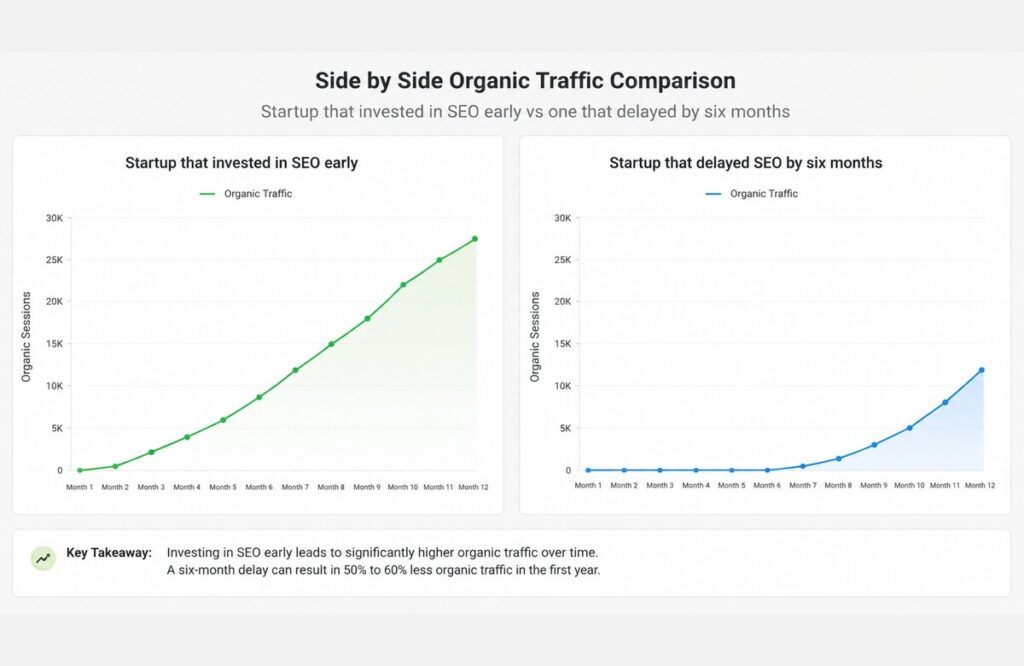
Here is what actually happens when a startup delays SEO for new businesses. Every month without SEO is a month a competitor is publishing content, earning backlinks, and building domain authority. That gap compounds.
A startup that starts SEO in month one is six months ahead of one that starts in month seven. That six-month gap can mean the difference between ranking on page one versus page three for your most valuable keywords a year from now.
The founders who treat SEO for startups as something to think about later are usually the same ones wondering why their website has no organic traffic eighteen months after launch. Early investment — even a modest one — pays back many times over compared to starting late.
Building the Right SEO Foundation for a Startup
Domain, Hosting, and Technical Setup
Before content. Before keywords. Before anything else, the technical foundation has to be solid.
Domain choice matters for startup SEO strategy more than people think. Rewrite this in a natural way: Stay brief and brandable, no hyphens. Don’t go for keyword stuffing like best-startup-seo-services-usa.com. Clean brand domains earn trust with users and Google over time.
Hosting speed directly affects rankings. Google’s Core Web Vitals update made page speed an official ranking factor. A startup running on cheap shared hosting with four-second load times is paying a ranking penalty before publishing a single word. Start with good managed hosting , SiteGround, Kinsta, or WP Engine (whichever you chose) and scale as you grow.
The SSL certificate must be active. HTTPS is a confirmed Google ranking signal. Every modern hosting provider includes this for free. There is no reason a new startup website should be running on HTTP in 2026.
The Pages Every Startup Website Needs From Day One
A lot of startup websites launch with a homepage, an about page, and a contact form. That is not enough for SEO for startups to work properly.
Every core service or product needs its own dedicated page with its own keyword target, its own optimized title tag, and its own unique content. A startup offering three services needs three service pages — not one page listing all three in bullet points.
A blog needs to exist from day one. Even if it starts with two posts, the structure needs to be there so content can be added consistently as the startup grows. Topical authority builds over time and time starts on the day you publish your first piece.
Location pages matter for any startup serving specific geographic areas. A startup offering SEO for new businesses in multiple cities needs individual pages for each location. Each one is a separate ranking opportunity that a single generic page cannot capture.
Our website SEO setup service handles this entire foundation for startups that want to get it right from the beginning rather than fixing problems six months later.

Keyword Strategy That Works When You Have No Authority
Why Long-Tail Keywords Are a Startup’s Best Friend
This is the single most important strategic insight in SEO for startups. New domains cannot compete for short, high-volume keywords. Not yet. Those keywords are owned by sites with years of backlinks and engagement data behind them.
Long-tail keywords are the answer. Specific three to five-word phrases with lower competition and higher purchase intent. A startup in the accounting software space cannot rank for “accounting software” on day one. But “accounting software for freelance photographers” or “simple invoicing tool for small contractors” — those are winnable.
HubSpot research shows that long-tail keywords account for 70% of all search traffic. The combined volume of specific searches dwarfs the traffic on broad terms. Organic growth for startups comes fastest by dominating a specific corner of a topic before expanding outward.
How to Map Keywords Before You Publish Anything
Keyword mapping is a step most startups skip and then wonder why their content is not ranking. The idea is simple — every page on your website gets assigned one primary keyword before it is written. No two pages target the same keyword. No keyword is left without a home.
Use Ahrefs, Semrush, or Ubersuggest to research keywords in your niche. Filter by difficulty below 20 for early content targets. See what your competitors are ranking for that you’re not yet doing. Take a look at the People Also Ask boxes that appear in the Google results, and you’ll get the exact questions your audience is asking. That data comes straight from real search queries.
Build a spreadsheet. Page URL, target keyword, secondary keywords, search volume and difficulty score. That spreadsheet becomes the master plan for your entire startup SEO strategy and it prevents the chaos of publishing content without a clear direction.
Content Marketing for Startups — How to Build Topical Authority Fast
What Topical Authority Actually Means for a Startup
Google does not just rank individual pages anymore. It evaluates entire websites for expertise on a topic. A startup that publishes twenty well-researched articles covering every angle of its niche signals to Google that this site knows its subject deeply.
That is topical authority. And it is one of the most powerful concepts in modern SEO for startups.
A startup does not need to cover every topic on the internet. It needs to cover its specific topic more completely than any competitor. A cybersecurity startup that has thirty detailed articles covering every aspect of small business cybersecurity will outrank a general tech blog that has two surface-level posts on the same subject — even if that tech blog has a higher overall domain authority.
The Content Types That Drive Startup SEO Growth
Not all content performs equally for content marketing for startups. Content formats that consistently dominate organic search.
How-to articles and tutorials perform well because they directly satisfy the informational search intent. Looking up “how to set up two-factor authentication for a small business” means you’re searching for instructions.. Give them exactly that — better than anyone else has.
Comparison posts capture commercial intent searches. “Tool A vs Tool B” searches happen constantly in every industry and the people making those searches are close to a purchase decision. A startup that owns comparison content in its niche is capturing high-value traffic that converts.
Original research and data earn backlinks naturally. A startup that publishes a survey or study with real data gives other sites something worth linking to. This is how early-stage startups with small link budgets can earn high-quality backlinks through content alone.
Here is a practical content structure that works for SEO for startups in the first six months:
- Publish 8-10 foundational how-to posts for your lowest competition keywords first, add 2-3 of comparison (product vs. product) posts, post one original piece of research or data content that generates natural backlinks, create location based content pages for all geographies you serve and update your best posts each quarter to maintain rankings/click-through rate.
Every piece should connect to related pages through internal links. Internal linking is how authority flows across your site — a strong blog post should pass some of that strength to your core service pages.

Technical SEO for Startups — What to Fix Before You Scale
Technical SEO for startups is not glamorous. Nobody gets excited about canonical tags and XML sitemaps. But ignoring technical issues while scaling content is like building floors on a cracked foundation.
Run your site through Google PageSpeed Insights every month. A mobile score above 80 is the minimum target. Compress every image before uploading — uncompressed images are one of the most common speed killers on startup websites. Use a caching plugin. Eliminate render-blocking scripts.
Google uses mobile-first indexing. Your mobile experience is not secondary — it is primary. More than 60% of searches are on mobile devices. Your startup has a gorgeous desktop site, but a broken mobile experience, and it’s losing over half of its organic traffic.
Core Web Vitals , Largest Contentful Paint, Cumulative Layout Shift, and Interaction to Next Paint , are all ranking signals. They’re all measurable. They are fixable. And they are things most startup competitors have not properly addressed, which means fixing them gives you a genuine ranking advantage.
Submit your XML sitemap to Google Search Console so every page gets crawled efficiently. Set up proper redirect chains — a 301 redirect from HTTP to HTTPS, from non-www to www. Add schema markup relevant to your business type. These are not optional extras for SEO for startups — they are baseline requirements for competing properly.
Our technical SEO audit service identifies every issue holding a startup site back in a single comprehensive session.
Link Building on a Startup Budget
Where Startups Can Win Backlinks Without a Big Budget
Backlinks remain a top-three Google ranking factor. A startup with zero backlinks is at a structural disadvantage. But link building does not require a massive budget — it requires strategy.
Guest posting on relevant industry publications works consistently when the pitch is specific and the content offer is genuinely useful. Reach out to blogs your target audience reads. Offer a specific topic — not a generic “I would love to write for you” email. Editors respond to concrete ideas that fit their audience.
HARO — Help a Reporter Out — connects journalists with sources. A startup founder responding to relevant queries with expert insight earns mentions and backlinks from news publications. These are high-authority links that most startups never pursue simply because they do not know the tool exists.
Local citations are a quick win for geo-targeted startups. Google Business Profile, Yelp, Bing Places, Apple Maps and niche directories all deliver local relevance signals and backlinks that help start-ups rank for local SEO.
Broken link building takes more effort but pays off. Find pages in your niche linking to resources that no longer exist. Reach out with your content as a replacement. It works more often than people expect and the links earned are genuinely valuable.
Our link-building services are built entirely around white hat acquisition strategies. No shortcuts that create short-term gains and long-term penalties.

Measuring SEO Progress as a Startup
Startups need to know if their investment is working. SEO for startups measurement is not complicated but it requires tracking the right things.
Google Search Console shows keyword impressions, clicks, average position, and indexing status. Check it weekly. You want to watch keywords that are ranking in positions eleven to twenty, these are your prime opportunities for quick wins by improving content.
Google Analytics 4 tells you the volume of organic traffic, landing page performance, and conversion paths. Enable goal tracking for your most important conversion actions , such as form-submissions, phone calls, demo requests, so you can link your SEO activity to real business results.
Use Ahrefs or Semrush to track keyword rankings on a monthly basis,. The movement of your target keywords in rankings is the clearest sign that your startup SEO strategy is producing results. Positions moving from thirty to fifteen to eight over three months tells a clear story.
Domain Rating or Domain Authority — measured by Ahrefs and Moz respectively — shows your overall link profile strength growing over time. For a new startup, moving from DR zero to DR twenty in the first year through legitimate link building is solid progress.
How Ecommerce Planners Help Startups Grow Through SEO
SEO for startups requires a fundamentally different approach than managing SEO for an established business. The keyword targets are different. The content priorities are different. The link building starting point is different. And the timeline expectations must be realistic and yet ambitious.
Since 2019 our team has developed organic search strategies for businesses that started from scratch in multiple industries. Aldo, Mango, Levi’s, Oladoc, and DaoPropTech put their trust in us for digital marketing. That experience informs every startup engagement we take on.
We handle the complete setup — technical audit and fixes, keyword research and mapping, on-page optimization across every page, content strategy built around your specific niche, and a link building plan calibrated to your budget and timeline. Our SEO packages are designed around where your startup is actually starting from — not a generic template applied to every client regardless of their situation.
Our content marketing services build the topical authority your startup needs to compete in organic search within the first year. Our digital marketing services combine paid search and social with SEO so your startup is getting traffic from multiple channels while the organic performance ages in the background
Each month you will get a simple report with rankings, organic traffic, the backlinks earned, and the next priority actions. No confusing dashboards. No metrics that look impressive but mean nothing. Just honest reporting on what is happening and what comes next.
Final Thought
Every startup that dominates organic search today started from the same place — zero authority, zero rankings, zero traffic. What changed is not magic. It is the consistent execution of the right strategy over enough time for the results to compound. SEO for startups is not the fastest channel. But it is the most durable one. Paid ads stop when the budget stops. Organic rankings keep working.
Ecommerce Planners has been building that kind of durable growth for businesses since 2019. Your startup deserves the same foundation. Start now — not later.
Get Your Free Startup SEO Audit — Find out exactly what your startup needs to rank on Google and start growing organic traffic from day one.
SEO generates $22 in revenue for every $1 spent on average — a 2,200% ROI. No other marketing channel compounds the way SEO does. Paid ads stop working the moment you stop paying. SEO keeps delivering years after the work is done.
Source: Orange SEO
FAQs
Q1. Is SEO worth it for startups?
Yes — and arguably more so than for established businesses. A startup investing in SEO for startups early builds compounding organic traffic that does not disappear when ad budgets run dry.Organic search accounts for 53% of all website traffic (BrightEdge), so for a startup on a shoestring budget, it’s hard to beat the ROI this channel delivers.
Q2. How long does SEO take for a startup?
Typically, you can expect meaningful ranking motion in three to six months for most startups. It takes up to a year for a competitive keyword in a saturated market. The trick is to target low competition keywords right away and steadily build topical authority with content while building backlinks at the same time , and the gains accelerate dramatically after month six.
Q3. What is the best SEO strategy for a startup?
Start with the technical, then keyword mapping, then content targeting the long-tail keyword you can rank for now. Parallel implement guest posting, citations, and HARO for backlinks. SEO for startups runs fastest when all three pillars , technical, content, and links , are running in parallel from the start.
Q4. How much should a startup spend on SEO?
Most early-stage startups spend $500 to $2,500 per month depending on the competition and growth potential of the niche. The more competitive, the more funding you need to make meaningful progress in search. A well-executed startup SEO strategy assessment before putting money into marketing will help make sure every dollar has a purpose.

