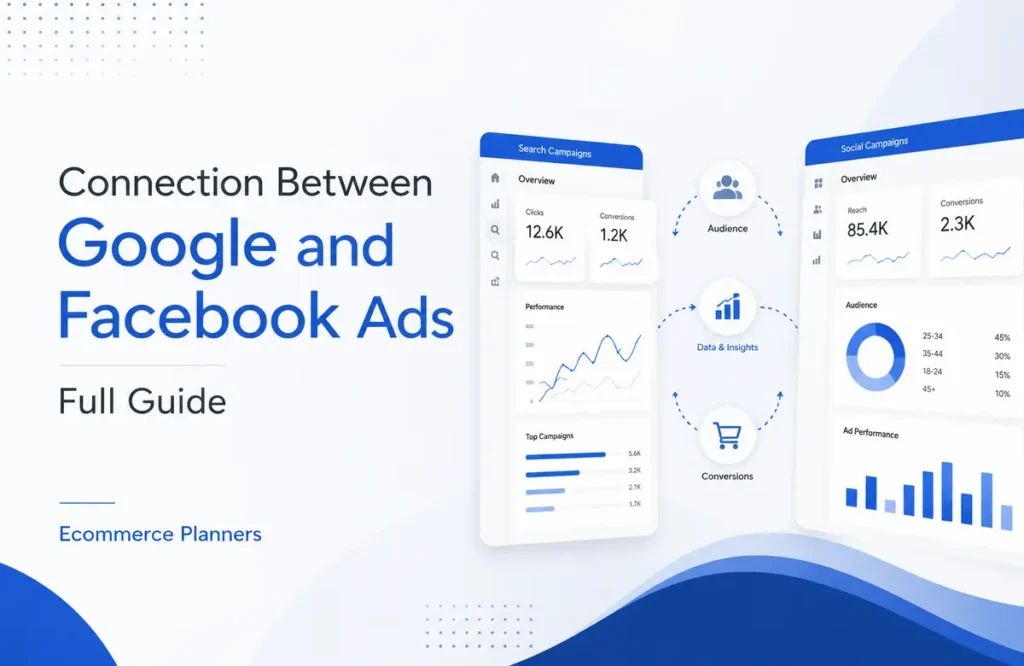
At Ecommerce Planners, our Google Ads management services team audits accounts regularly where Google and Facebook campaigns are running simultaneously but tracked as if they share nothing in common. Two dashboards. Two budget conversations. Two optimization strategies that never cross-reference each other. The result is predictable — businesses cut whichever platform looks worse in isolation without understanding that the one they cut was quietly feeding the one that appeared to be working.
That is the problem this article addresses directly. By the end, you will understand precisely how the connection between Google and Facebook Ads operates at every stage of the customer journey — and how to structure, measure, and protect spend across both.
How Google Ads Captures Existing Demand
The Intent Signal Behind Every Search Query
When someone types “emergency roof repair Dallas” into Google, the decision architecture is already formed. They have a problem. They want a solution. and they are ready to evaluate and act. Google Ads enters this moment not by creating interest but by responding to it — matching a structured ad to a query that already carries commercial intent.
The auction mechanism reflects this. Quality Score — Google’s composite measure of expected click-through rate, ad relevance, and landing page experience — determines position as much as bid amount. An advertiser bidding $4 with a highly relevant ad can outrank a competitor bidding $9 with a generic one. The platform rewards intent-matching, not spending power alone. This same intent-matching principle is what separates a profitable campaign from wasted spend — something we break down further in our guide on Google Ads for website traffic.
Where Google Ads Fits in the Customer’s Decision Cycle
Google Ads is a capture mechanism, not a creation tool. It intercepts demand that already exists. A roofing company running search campaigns does not create the desire to fix a roof — it captures that desire at the moment a homeowner acts on it.
The structural limitation follows directly from this. If the category is unfamiliar or the product is genuinely new — a software tool solving a problem users have not yet named, a service category that is not yet searchable by intent — Google Search Ads have no demand to intercept. The search volume simply does not exist until something outside the platform creates it.
How Facebook Ads Create New Demand
Behavioral and Interest-Based Targeting Explained
Facebook’s targeting infrastructure operates on accumulated behavioral signals — pages followed, content engaged with, purchases made, videos watched, and links clicked. These signals are not intent signals in the way a search query is. They are behavioral footprints that allow advertisers to reach audiences who match the profile of people who would be interested in a product before those people have formed the desire to search for it.
Lookalike audiences extend this further. Upload a customer list and Meta builds an audience that mirrors its behavioral characteristics across its broader user base. A financial planning firm targeting recent retirees does not need those users to have searched for retirement advice — it needs their behavior on the platform to match the behavioral signature of people who have already become clients. This is the same audience-building logic behind our social media marketing services — using behavioral data to find people before they start searching.
Where Facebook Ads Fit in the Customer’s Decision Cycle
Facebook Ads operates before the search query forms. A user who has never considered home automation sees a video in their Instagram feed demonstrating how a smart thermostat cut a family’s energy bill. They do not click. They scroll. But an impression has registered — the brand name, the problem category, the emotional frame of the solution.
The limitation here is conversion speed. That same user is unlikely to pull out a credit card immediately after an Instagram video interruption. The Facebook environment is not a commercial decision space. It is a discovery and narrative space. Expecting cold Facebook traffic to convert at the same rate as high-intent Google search traffic misunderstands where Facebook sits in the psychology of purchase decisions.
The Real Connection Between Google and Facebook Ads
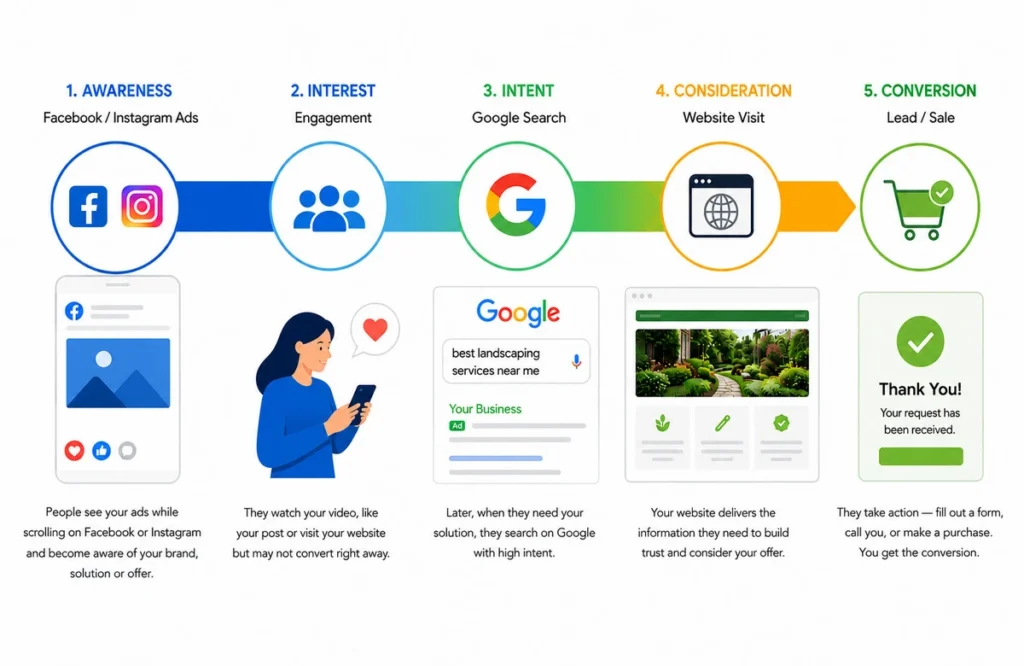
One Customer Journey, Mapped From First Impression to Purchase
Consider a mid-size landscaping company in Phoenix. They run Facebook video ads in spring showing time-lapse transformations of residential yards — targeted at homeowners aged 35 to 60 in zip codes with median home values above $400k.
A viewer watches twenty seconds of one video in late March. Does not click. The algorithm registers the watch event.
Two weeks later, that same homeowner is sitting on their back patio realizing the lawn looks worse than the video they saw. They open Google and search “landscaping company Phoenix.” The landscaping company’s search ad appears. The Facebook exposure made the brand name recognizable when it appeared in the search results. The click-through happens. The lead converts.
In last-click attribution, this conversion is credited entirely to Google. The Facebook ad spend that made the brand recognizable at the search results page — that lowered the hesitation threshold between seeing the name and clicking it — receives zero credit. The contribution is real. The measurement is blind to it.
The Attribution Gap Most Businesses Overlook
This is not a theoretical problem. Meta’s own conversion research found that last-click attribution misattributes 60 percent or more of Facebook-influenced conversions to other channels. Google’s own research on consumer purchase journeys documented that the average purchase involves between 6 and 8 touchpoints before conversion, distributed across channels and days.
When only the final click is credited, the earlier touchpoints look like waste. The budget review conclusion writes itself — cut the platform that produced no attributed conversions, keep the one that produced all of them. But what is actually cut is the top-of-funnel activity that made the bottom-of-funnel activity possible.
The Hidden Cost of Measuring Platforms in Isolation
A SaaS company running a $4,000 per month Facebook awareness campaign cuts it after sixty days because the Facebook dashboard shows $210 cost per lead — well above the $80 target. Google Ads performance looked strong at $72 cost per lead, and the team decided to concentrate the budget there.
Three months later, Google’s conversion volume has dropped 35 percent. CPCs have risen. The account manager suggests bidding higher. The real problem — the top-of-funnel brand awareness feeding branded search queries and reducing friction at the bottom — has been removed. The Google pipeline dried up because the Facebook pipeline feeding it was eliminated. The two numbers were never read in relation to each other.
The following section maps exactly where each platform belongs so the relationship between them becomes a structural decision, not a reactive one.
Mapping the Full Funnel Across Both Platforms
Top of Funnel — How Facebook Builds Awareness
At the awareness stage, the creative format matters as much as the targeting. Short-form video — fifteen to thirty seconds — consistently outperforms static image ads for cold audience reach because it generates watch events that the platform interprets as engagement signals, feeding the audience pool for subsequent retargeting.
Success at this stage is not measured in conversions. It is measured in reach frequency, video completion rate, and cost per thousand impressions against a well-defined audience. A dental group running awareness video ads across a metro area should not be optimizing for form fills at this stage. The goal is coverage — being seen by the right people enough times that the brand name registers before the dental emergency creates the search query.
Landing pages sent from top-of-funnel Facebook traffic should go to educational content, not service pages. A user who clicked from a cold awareness ad and lands on a pricing page will almost certainly bounce. The mismatch kills both the conversion and the signal quality being sent back to Meta’s optimization algorithm.
Middle of Funnel — Where Retargeting Connects Both Platforms
This is the stage most advertisers skip or underinvest in — and the stage where the connection between Google and Facebook Ads operates most directly.
Retargeting Facebook Engagers Through Google Display
Users who watched 50 percent or more of a Facebook video ad can be exported as a custom audience and uploaded to Google Ads as a customer match list. This list becomes the targeting basis for a Google Display campaign that follows these users across the web — showing banner ads that reference the Facebook creative they already engaged with. The message can shift from awareness to consideration: “Still thinking about it? Here is what our customers say.”
This creates a cross-platform retargeting sequence that most competitors are not running. The user experienced Facebook as the discovery channel and now encounters the brand again in a completely different digital environment — reinforcing without repeating.
Retargeting Google Visitors Through Facebook
The reverse flow works equally well and is more commonly practiced but still poorly executed. A user who visited a Google Ads landing page but did not convert gets added to a Facebook Custom Audience via the Meta Pixel. The retargeting campaign they see on Facebook should not be a replica of the Google ad. It should be a different format — a testimonial video, a case study carousel, a limited offer — that addresses the hesitation implied by the non-conversion.
The mistake most accounts make here is running the same message in the Facebook retargeting campaign that the user already declined to act on from Google. The second touchpoint needs to add new information or reframe the value proposition, not restate it.
Bottom of Funnel — How Google Closes the Sale
By the time a user reaches a bottom-of-funnel Google search, the psychological work has been done elsewhere. They know roughly what they want. They are evaluating which provider to choose. The Google ad at this stage needs to do one thing well — be the most relevant result for the specific query being made.
This is where landing page specificity becomes a direct revenue variable. An ad for “commercial HVAC contractor Atlanta” that sends traffic to a homepage — rather than a page specifically about commercial HVAC services in Atlanta — loses a conversion the top and middle of the funnel already earned. The work done in the awareness and consideration stages is wasted at the landing page if the page fails to match the intent of the search.
Specificity at the bottom of the funnel applies to ad copy too. Mentioning the service, the location, and one differentiator in the headline — not a brand name and a tagline — is what produces the click-through rate that wins the conversion.
Structuring Ad Spend Across Both Platforms
A Decision Framework Based on Business Stage
A new brand entering a market with no existing search volume for its category has no Google Search demand to capture. Facebook becomes the only viable paid channel until awareness builds enough to generate search behavior. A new productivity software category — where users are not yet searching “task automation for remote teams” — needs Facebook to educate the market before Google becomes useful.
An established service business in a category with clear search volume faces the opposite situation. The demand exists. People are searching. Google captures it efficiently. Facebook becomes the amplifier — building brand familiarity that improves Google conversion rates, creating retargeting pools that extend the conversion window, and generating awareness among users who match the customer profile but have not yet entered the search cycle.
E-commerce businesses typically run both simultaneously from early stages because the product is searchable and the visual format of Facebook ads is matched to purchase behavior. The budget split follows performance data — more toward Facebook in product launch phases when search volume is low, more toward Google Shopping as category search volume grows.
When to Shift Budget Between Platforms
Budget shifts should be tied to specific metrics, not vague performance impressions.
If branded search volume in Google is declining month over month while Facebook reach is flat, the signal is that top-of-funnel activity is insufficient — increase Facebook investment before the Google pipeline contracts further. If Google CPCs are rising while Facebook cost per video view is stable, the auction is becoming more competitive at the bottom of the funnel — more top-of-funnel Facebook investment can improve Google performance by increasing the proportion of warm-to-cold traffic in the search results click pool.
Measuring the Connection: Cross-Platform Attribution
Setting Up Multi-Touch Tracking in GA4
GA4’s data-driven attribution model is the practical starting point for cross-platform measurement. In the Admin panel, navigate to Attribution settings and switch from last-click to data-driven attribution. This distributes conversion credit across all touchpoints in the path based on their observed contribution — not just the final one.
This requires that all traffic sources carry UTM parameters. GA4 cannot attribute what it cannot identify. Every ad — across both platforms — needs source, medium, campaign, and content parameters populated consistently before data-driven attribution can function accurately.
Maintaining UTM Discipline Across Both Platforms
A consistent UTM structure looks like this in practice: utm_source=facebook, utm_medium=paid-social, utm_campaign=spring-awareness-2026, utm_content=video-30s-homeowners. The parallel Google structure: utm_source=google, utm_medium=cpc, utm_campaign=branded-search, utm_content=headline-v2.
The discipline required is consistency across every ad variant, every campaign launch, every platform. A single untagged ad breaks the attribution path for every user who converts after clicking it. Maintaining a UTM naming convention document and reviewing it at campaign launch — not after — is the operational habit that makes cross-platform attribution reliable.
Metric Pairs Worth Monitoring Together
Branded search volume against Facebook reach trends is the single most useful metric pair for diagnosing top-of-funnel health. When Facebook reach drops — due to budget cuts, audience fatigue, or creative burnout — branded search volume typically follows within two to four weeks. Tracking both in the same report makes this relationship visible before the Google conversion impact is felt.
The Facebook cost per video view against the Google click-through rate is a second useful pair. Rising CPV on Facebook often signals audience saturation. When this coincides with declining Google CTR, both are symptoms of the same underlying problem: message fatigue across the full customer journey, not a platform-specific failure.
Mistakes That Undermine a Cross-Platform Strategy
Measuring Each Platform in Isolation
The consequence is systematic misallocation — cutting the channel that appears to underperform while eliminating the upstream activity that made the other channel’s performance possible. What looks like a budget optimization decision becomes a pipeline destruction decision six weeks later.
Inconsistent Messaging Between Ads and Landing Pages
A user who clicks a Facebook video ad about sustainable home renovation and lands on a generic home improvement services page experiences a message gap that breaks trust at the exact moment intent is forming. The consequence is a high bounce rate that damages the remarketing audience quality being built for Google retargeting — the mismatch compounds across funnel stages.
Cutting Awareness Spend Under Short-Term Pressure
The consequence is delayed — typically four to eight weeks — which makes the causal relationship invisible without cross-platform tracking. Google conversion volume appears to decline for unexplained reasons. The explanation is the Facebook awareness budget that was cut two months earlier.
Building One Advertising System, Not Two Channels
Google Ads and Facebook Ads are not competing for the same role in your marketing. They serve different psychological stages of the same customer — Facebook encounters people before they know what they want, and Google responds to them once they do. Running them as separate budget lines with separate success metrics guarantees that the connection between them is never optimized — and never even measured.

The businesses that consistently outperform single-platform competitors in their markets are not spending more. They are building one system where Facebook awareness makes Google search more efficient, where retargeting flows cross both platforms, and where attribution is tracked across the full customer journey rather than just the final click.
If you are running both platforms and want to build them into a coordinated system, our Digital marketing services are built exactly for this. Contact Ecommerce Planners to start with a cross-platform audit.
Modern buying journeys rarely happen on a single platform. According to Google Analytics attribution documentation, customers often perform multiple searches and interact with multiple ads before completing a conversion, which is why relying on one advertising channel can create an incomplete picture of performance.
Source: Google
Frequently Asked Questions
Is Facebook Ads better than Google Ads?
Neither platform is superior — they address different stages of customer psychology. Google captures demand that already exists through search intent. Facebook creates demand by reaching people before they know what they want. Asking which is better is like asking whether awareness or conversion matters more — both are required for a complete customer acquisition system.
Should a business run Google and Facebook Ads at the same time?
It depends on business stage. A new brand in a category with no search volume should start with Facebook to build awareness before Google search demand exists to capture. An established business in a searchable category can run both simultaneously — Google for bottom-of-funnel conversion and Facebook for top-of-funnel demand creation and retargeting. The decision framework in the budget section above gives specific criteria for each scenario.
How does Facebook Ads affect Google Ads performance?
Facebook Ads builds the brand familiarity that improves Google click-through rates and conversion rates when those users later conduct a search. A user who has seen your Facebook ad twice is more likely to click your Google ad and more likely to convert on your landing page than a cold search visitor with no prior brand exposure. Last-click attribution hides this contribution because Google gets the credit for a conversion that Facebook partially earned.
What is the ideal budget split between Google and Facebook Ads?
There is no universal ratio. A new brand typically allocates more to Facebook in early stages and shifts toward Google as search volume develops. An established service business often runs a higher proportion through Google Search while using Facebook primarily for retargeting. Monitor branded search volume trends against Facebook reach to identify when top-of-funnel investment needs adjustment.
Can a small business afford to run both platforms at once?
Not always simultaneously — sequencing is often smarter than splitting a limited budget. Start with the platform that matches where your customer is in their decision cycle. If search volume exists for your service, start with Google. If the category is not yet searchable or brand awareness is genuinely low, start with Facebook. Once one platform produces consistent returns, add the second and connect them through retargeting. Running both at a budget too thin to generate actionable data on either produces worse outcomes than running one platform well.

