
Businesses spent over $237 billion on Google advertising in 2025. Most of them did not get $237 billion worth of results back. The problem is not a lack of budget or effort — it is a lack of structural discipline around what profitable advertising actually requires. They are paying for clicks that never had a realistic chance of converting. At Ecommerce Planners, we build Google Ads campaigns that generate measurable return on investment. Knowing how to advertise on Google Ads is not about finding the cheapest clicks.
It is about building a system where the right person sees the right message at the right moment and lands somewhere designed to convert. Every component — account structure, keyword selection, ad copy, landing page, tracking — has to work together. This guide covers everything from campaign foundation to scaling strategy so you understand exactly what separates profitable campaigns from money-wasting ones.
Why Most Google Ads Campaigns Fail Before They Even Launch
The Cost of Advertising Without a Clear Objective
Most failing campaigns share one starting point — someone added keywords that seemed relevant and hit launch. No defined objective. No measurement framework, or no benchmark for success. Google’s default settings are not designed to protect your budget — they are designed to generate impressions and clicks. Without a clearly defined campaign objective — cost per lead target, ROAS threshold, conversion volume goal — there is nothing to optimize toward and no way to catch underperformance before the budget is gone.
Why Traffic Alone Does Not Generate Revenue
A campaign generating 500 clicks per day is not successful until you know what those clicks do after landing. Traffic is a means to an end. The end is customers, bookings, purchases, form submissions — actions that translate into actual revenue. Campaigns built around maximizing click volume optimize for the wrong outcome. Google’s algorithm finds clicks efficiently. Whether those clicks come from people who will ever become customers is a question the campaign structure has to answer before spend begins.
The Importance of Aligning Ads With Business Goals
A service business generating $3,000 per closed client can afford a much higher cost per lead than a product business with a $40 average order value. The entire campaign architecture should be calibrated around this economic reality from day one. google ads strategy that starts from business economics rather than platform defaults is the single most reliable differentiator between profitable accounts and struggling ones.

Building the Foundation for a Profitable Google Ads Campaign
Identifying High-Value Customers
Before choosing a single keyword, identify who your highest-value customers are and what they search when they are ready to act. Not all clicks are worth the same. A plumbing company getting leads for emergency pipe repairs generates different revenue per customer than one getting leads for drain cleaning. The keyword strategy should weigh toward the higher-value service category. A simple customer profile — what they search, what they need, what they compare — shapes every downstream decision in the campaign.
Understanding Search Intent Before Choosing Keywords
Search intent falls into four categories: informational, navigational, commercial, and transactional. The most valuable for Google Ads are commercial and transactional — queries from people evaluating options or ready to act. Someone searching “what is a commercial architect” is in research mode. Someone searching “commercial architect in Austin for office project” is evaluating providers. The second search costs more per click and converts at dramatically higher rates. Understanding this before building keyword lists prevents budget from going to searches that educate rather than convert.
Creating an Offer People Actually Want to Click
The offer needs to be clear, specific, and directly relevant to the search just made. “Free consultation” is weak. “Free thirty-minute strategy session to review your Google Ads account” is specific and valuable. Strong offers reduce cost per lead independently of everything else by converting a higher percentage of the clicks already being paid for.
Establishing Success Metrics From Day One
Before launch, three numbers need to be defined: the maximum acceptable cost per lead, the target conversion rate on the landing page, and the minimum ROAS for the campaign to be worth continuing. These numbers create a decision framework that makes optimization obvious — it is also what separates amateur setups from professional google ads management services that optimize toward real business outcomes.
How to Advertise on Google Ads Without Wasting Your Budget
Setting Up Your Google Ads Account Correctly
Conversion tracking must be installed and verified before the first dollar is spent. This is non-negotiable. Without accurate conversion data, every optimization decision that follows is built on guesswork. Google Tag Manager is the most reliable implementation method. Install the base Google Ads conversion tag through GTM, create a separate tag for each conversion action — form submissions, phone calls, booking confirmations, purchases — and test every tag using GTM’s preview mode before going live. Google Analytics 4 should be linked to the Google Ads account and properly configured for cross-channel attribution.
Choosing the Campaign Type That Matches Your Goals
For most businesses starting their first Google Ads campaign, Search campaigns are the right choice — they reach people at the moment of explicit intent. Display campaigns work for remarketing to past visitors. Performance Max campaigns access all Google surfaces through automation — useful when conversion data is strong and the account has established performance history, not as a starting point. Shopping campaigns are purpose-built for e-commerce. YouTube campaigns work at the awareness stage but perform differently from intent-based search.
Configuring Location and Audience Targeting
Overly broad location targeting is one of the most reliable sources of wasted spend. A service business covering a 30-mile radius should not be targeting an entire state. Set location targeting to your actual service area and use the location options setting to target people in or regularly in the location — not just people who show interest in it. Audience targeting in Search campaigns should start with observation mode, collecting data without restricting delivery. After four to six weeks, performance data by audience segment tells you which groups are converting efficiently and which are not.
Structuring Campaigns for Better Performance
Each campaign should target one clearly defined service or product category with its own budget, bid strategy, and performance targets. Combining multiple services into one campaign makes budget allocation impossible. Ad groups within each campaign should be tightly themed — 5 to 15 closely related keywords sharing a common intent. Each ad group gets its own responsive search ad written specifically for that keyword theme. This tight structure is what makes Quality Score improvements achievable and keeps ad relevance high enough to compete without overspending.
Launching With Data Collection in Mind
The first thirty days of a new campaign are a data collection phase, not an optimization phase. Launch with conservative bids — manual CPC or Maximize Clicks with a bid cap — to gather search term data, conversion rate data, and audience performance data before spending aggressively. Every optimization decision made in months two and three will be better for this initial restraint.
The Keyword Selection Framework Used by High-Performing Advertisers
Prioritizing Commercial Intent Over Search Volume
High search volume keywords are expensive, competitive, and frequently attract traffic that does not convert. The keyword “emergency plumber available tonight” generates a fraction of the volume of “plumber” and converts at multiple times the rate because the intent is explicit. Google Ads keyword selection should weight heavily toward specificity and buyer intent over volume. This is where most self-managed accounts leave money on the table.
Understanding Match Types Without Overcomplicating Them
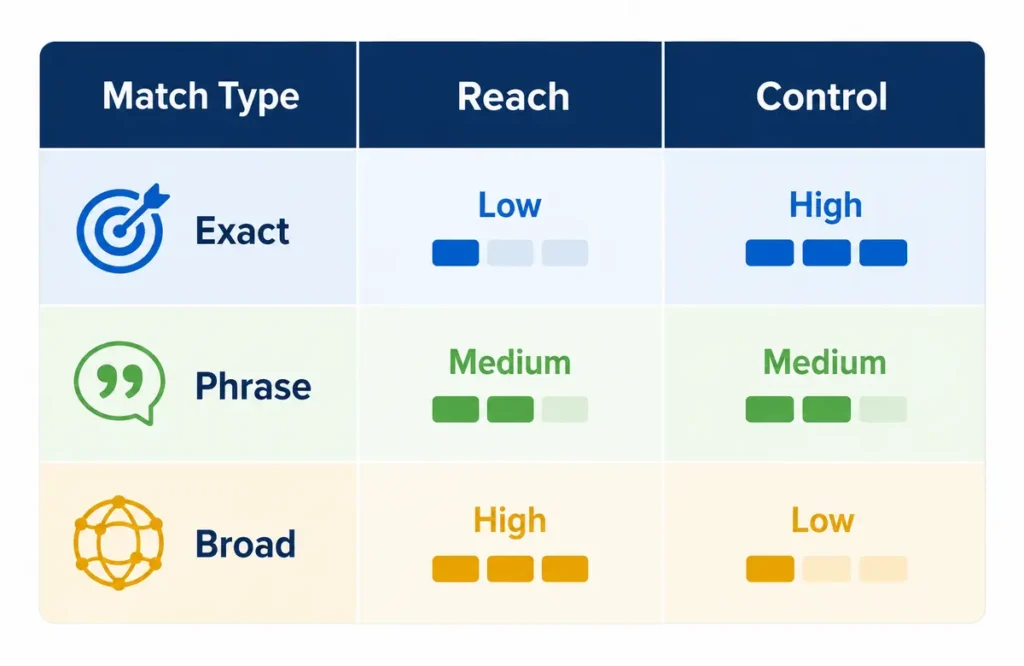
Exact match restricts ads to closely matching searches — highest relevance, lowest reach. Phrase match triggers for searches containing the keyword phrase — broader reach with reasonable relevance. Broad match triggers across a wide range of related searches — maximum reach, least predictable relevance, highest risk of wasted spend. For most new campaigns, starting with exact and phrase match — and adding broad match only where conversion data supports Smart Bidding — produces better early results.
Using Negative Keywords to Protect Ad Spend
Negative keywords are exclusions that prevent ads from appearing for searches that waste budget. Before launch, build a foundational negative keyword list — terms like “free,” “DIY,” “jobs,” “salary,” “course,” “tutorial.” After launch, review the search terms report weekly and add every irrelevant search to the negative keyword list immediately. This ongoing exclusion process is what steadily improves campaign efficiency month over month — and one of the most overlooked benefits of ppc marketing that self-managed accounts rarely take advantage of.
Finding Low-Competition Opportunities Competitors Ignore
Long-tail keywords — three- to five-word phrases with specific intent — consistently offer lower CPCs and higher conversion rates than head terms. The strategic opportunity is in the specific queries: “Google Ads management for roofing contractors” rather than “Google Ads management,” “kitchen remodeling contractor Austin quote” rather than “kitchen remodeling.”
Writing Ads That Earn Clicks From the Right People
Crafting Headlines Around Customer Motivation
Responsive search ads allow up to fifteen headline variations, and Google’s algorithm tests combinations to find the highest-performing assemblies. Write headlines that speak directly to the customer’s motivation — the problem they are trying to solve, the outcome they want, or the specific service they searched for. The highest-performing headline typically mirrors what the person typed into the search bar. Including the search term or a close variant signals immediate relevance and produces higher click-through rates.
Communicating Value Within Limited Ad Space
Each headline has a 30-character limit. Each description has a 90-character limit. Every character has to work. Vague claims — “quality service,” “trusted professionals,” “best in the industry” — consume space without communicating anything specific. Replace them with numbers, specifics, and outcomes: “24-Hour Response Guaranteed,” “Licensed Since 2009,” “Free Audit — No Obligation.”
Building Trust Before the Click Happens
Ad extensions — now called assets in Google Ads — are the trust-building layer of a well-structured ad. Sitelink, callout, structured snippet, call, and review extensions all add credibility before the user clicks anything. Fully populated ad assets improve Quality Score, increase the physical size of the ad on the results page, and communicate trust before a single dollar is spent on a click.
Creating Calls to Action That Encourage Action
The call to action tells the user what to do next. “Call Now,” “Get a Free Quote,” “Schedule Your Consultation,” “See Our Work” — Each is more effective than a generic “Learn More” or “Click Here” because it sets a clear expectation — the same principle that drives strong content marketing, where every word serves a specific conversion purpose.
Turning Ad Clicks Into Customers Through Better Landing Pages
Why Message Consistency Improves Conversion Rates
The landing page must match the promise the ad made. An ad about commercial roofing that lands on a homepage with no commercial roofing content creates a gap that most users resolve by leaving immediately. Message consistency — same service, same offer, same visual tone — signals to the user they are in the right place. Conversion rate optimization starts with this match before anything else.
Reducing Friction Throughout the Customer Journey
The optimal landing page for paid traffic has one goal, one message, one call to action. Long forms, unnecessary required fields, slow load times, and navigation options that pull users away from the conversion goal all cost money. The fewer decisions a visitor has to make, the higher the percentage that make the one that matters.
Leveraging Social Proof to Increase Trust
Reviews, testimonials, case study snippets, client logos, and verifiable statistics all reduce the hesitation between a click and a conversion. A user landing on a page showing a case study documenting a 3.8x ROAS improvement for a comparable business is significantly more likely to fill out a form than one landing on a page with a generic value proposition.
Optimizing the Mobile Experience
Over 60 percent of Google searches happen on mobile devices. Page speed on mobile is a direct revenue variable — every second of load time above three seconds measurably reduces conversion rate. A landing page that renders poorly on mobile is effectively wasting the majority of its paid traffic — a problem any experienced ecommerce digital marketing agency addresses before a single dollar is spent.
Budget Allocation Strategies That Improve Return on Ad Spend
Determining an Appropriate Starting Budget
The starting budget needs to be large enough to generate meaningful conversion data within thirty days — enough daily spend to produce 50 to 100 clicks per day. Starting too low prolongs the data collection phase and delays optimization. Starting too high before the campaign structure is validated amplifies structural mistakes.
Investing More in High-Intent Traffic
Search campaigns targeting transactional keywords should receive higher CPCs and larger budget allocations than informational keyword campaigns. Within a campaign, bid adjustments can direct additional spend toward the audience segments, geographic locations, device types, and times of day that convert at the highest rates.
Choosing Between Manual and Automated Bidding
Manual CPC prevents the algorithm from spending aggressively before it has data. Maximize Conversions with a target CPA is Google’s most widely effective automated bidding strategy — but it requires at least 30 to 50 conversions per month to optimize reliably. The transition from manual to automated bidding should happen when conversion volume supports it, not as a default starting point.
Scaling Budgets Without Sacrificing Profitability
Increasing budget works when the campaign is producing conversions within the target CPA range. Scale incrementally — increases of 15 to 20 percent per week allow the algorithm to adjust without destabilizing its learned bidding patterns. Doubling a budget overnight on a campaign using automated bidding typically triggers a learning phase reset and temporarily degrades performance.
Measuring What Actually Matters in Google Ads
Tracking Conversions Accurately
Conversion tracking is the non-negotiable foundation of every measurement decision. Verify tracking monthly. Check for duplicate tags that inflate conversion counts. Confirm phone call conversions are firing correctly. Ensure the conversion window matches the typical decision timeline of your customers.
Understanding Cost Per Acquisition
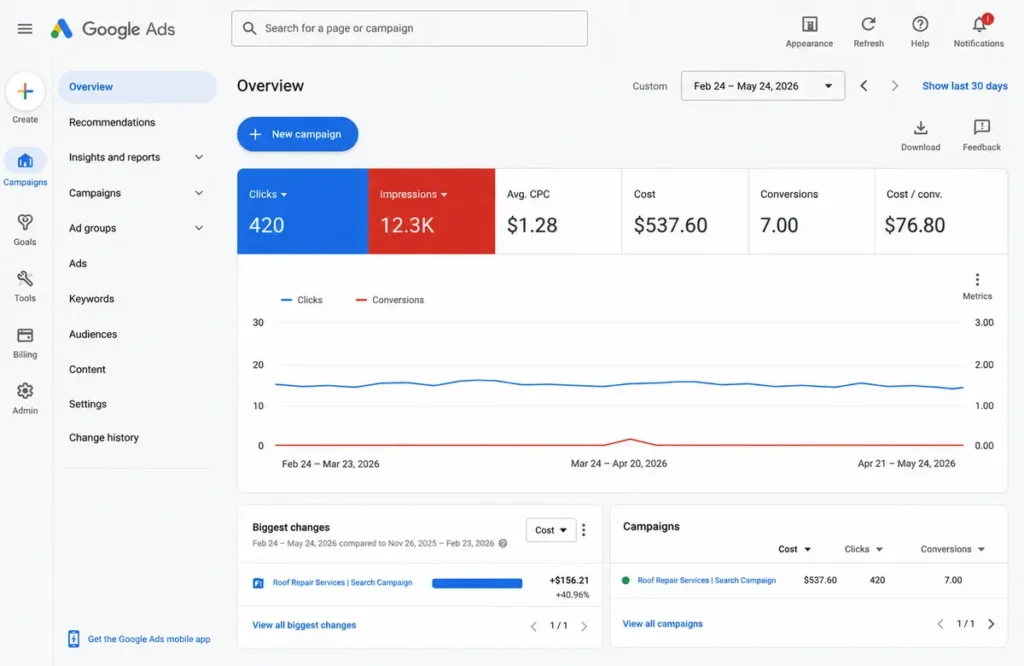
CPA is the total spend divided by the number of conversions — the primary efficiency metric for lead generation campaigns. A CPA below the maximum acceptable cost per lead is the green light for scaling. A CPA above that threshold triggers a diagnostic review of keyword quality, landing page conversion rate, and offer relevance.
Evaluating Return on Ad Spend
ROAS — revenue divided by ad spend — is the primary efficiency metric for e-commerce campaigns. A 4x ROAS means the campaign generates $4 in revenue for every $1 spent. Whether a given ROAS is acceptable depends on product margins — a business with 20 percent margins needs significantly higher ROAS than one with 60 percent margins to remain profitable.
Looking Beyond Click-Through Rates
CTR measures how often people click after seeing the ad. High CTR does not equal success if those clicks do not convert. A campaign with a 15 percent CTR and a 0.5 percent conversion rate is less effective than one with a 5 percent CTR and a 4 percent conversion rate. Optimizing for CTR in isolation can actively harm profitability.
Performance Optimization Techniques Used by Experienced Advertisers
Improving Quality Score Over Time
Quality Score is Google’s 1 to 10 rating of keyword relevance, ad relevance, and landing page experience. Higher scores produce better ad positions at lower CPCs. Tighten the relationship between keyword, ad copy, and landing page content. An ad group targeting “emergency HVAC repair” should have ad copy mentioning emergency HVAC repair, and a landing page that opens with a headline about emergency HVAC service.
Refining Audience Segments
After 60 to 90 days in observation mode, audience performance data shows which segments convert most efficiently. In-market audiences, remarketing lists, and customer match lists can each receive bid adjustments based on observed conversion rate differences. Users who have previously visited your site typically convert at higher rates than cold audiences and justify higher CPCs.
Using Search Term Data to Improve Relevance
The search terms report is the most actionable optimization tool in Google Ads. Reviewing it weekly produces two improvements simultaneously: new negative keywords from irrelevant queries, and new exact match keywords from highly relevant searches currently served by broader match types.
Running Structured A/B Tests
Change one variable at a time — one headline, one description line — and run tests long enough to reach statistical significance. A test run for three days with 20 conversions means nothing. A test run for 30 days with 100 conversions per variant is meaningful.
Scaling Winning Campaigns for Sustainable Growth
Expanding Into New Markets
A campaign producing strong ROAS in one market can be replicated in additional cities or regions by creating location-specific ad groups and landing pages. The winning structure and messaging transfers — only the location references change. This is the most reliable scaling method for local service businesses.
Re-Engaging Previous Website Visitors
Remarketing campaigns reach users who have visited the site but not converted. These audiences have brand familiarity, which typically produces higher conversion rates at lower CPCs than cold traffic. Remarketing lists for Search Ads allow bid adjustments for past visitors when they search relevant terms again — reaching the warmest possible audience at their next moment of intent.
Leveraging Performance Max Campaigns
Performance Max campaigns access all Google surfaces — Search, Display, YouTube, Discover, Gmail, Maps — using automated optimization to find conversions. They perform best with substantial historical conversion data, strong creative assets, and clearly defined conversion goals. Using PMax before these conditions are met tends to produce opaque spend allocation and inconsistent results.
Using Automation Without Losing Control
Google’s automation tools improve efficiency when given accurate conversion data, appropriate asset variety, and clearly defined campaign goals. Review automated campaign performance weekly. Apply negative keyword lists to PMax campaigns — failing to do so allows significant irrelevant traffic that erodes results.

Final Thought
Long-term success with Google Ads comes from building a system — not launching a campaign. The businesses generating consistent profitable results are not the ones with the largest budgets. They are the ones that set clear objectives, track the right metrics, maintain structural discipline, and optimize based on conversion data rather than surface metrics. Scaling comes after the fundamentals are working — not before. The most reliable path to knowing how to advertise on Google Ads profitably is getting the foundation right and letting the data guide every decision that follows.
Contact Ecommerce Planners today and let us build a Google Ads campaign that earns more than it costs. Whether you are starting from scratch or fixing a struggling account, we handle everything from structure to scaling.
Google’s own help documentation states that Ad Rank is calculated using your bid amount, ad quality, Ad Rank thresholds, auction competitiveness, search context, and the expected impact of ad assets — and that a high-quality, highly relevant ad can win a better position at a lower price even against a higher-bidding competitor.
Source: Google
FAQ Section
How much should I spend when starting Google Ads?
The starting budget should generate 50 to 100 clicks per day — roughly $500 to $1,000 per month in local markets and $2,000 to $5,000 in competitive categories like legal or financial services. Starting below this threshold delays meaningful optimization.
Is Google Ads still profitable in 2026?
Yes — for businesses with structured campaigns, accurate tracking, and offers that match search intent. The platform is more competitive than five years ago, requiring more active management than a set-and-forget approach.
How long does it take to see results from Google Ads?
Initial traffic data appears in the first week, but meaningful optimization typically takes 30 to 60 days of conversion data. Judging viability before that window closes leads to premature campaign shutdowns.
What is considered a good ROAS?
There is no universal threshold — it depends on your margins. Calculate your target by dividing gross margin percentage by your target advertising cost of sale. Any ROAS above that number is profitable.
Which campaign type performs best for lead generation?
Search campaigns targeting commercial and transactional keywords consistently produce the highest lead quality. Local Services Ads are also strong for eligible categories since they charge per lead rather than per click.
Can small businesses compete with larger advertisers?
Yes — on intent-matched keywords in specific geographic markets. Quality Score neutralizes raw spending power, allowing a tightly structured local campaign to outperform a national advertiser with generic creative.
How often should Google Ads campaigns be optimized?
Search term reports and negative keywords should be reviewed weekly. Bid adjustments and budget allocation should be reviewed monthly. Ad copy tests should run 30 to 60 days before conclusions are drawn.

