
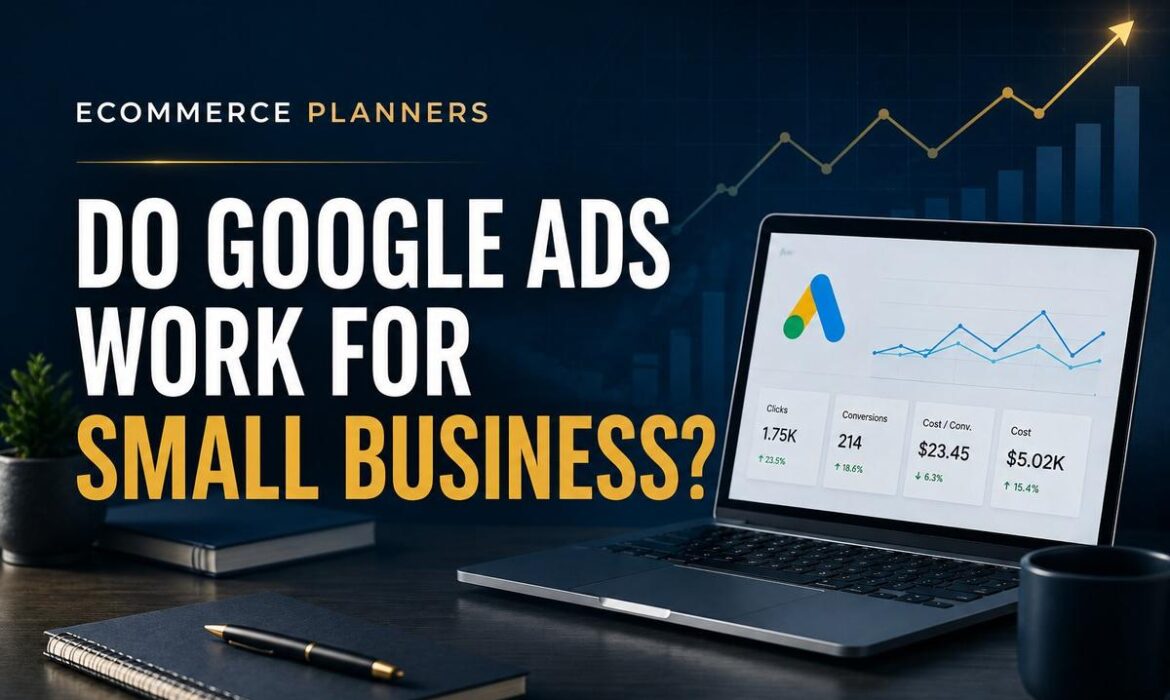
Yes. Google Ads work for small businesses. But here is the part nobody leads with — they only work when the campaign is actually built right. And most are not.
Walk into the average small business Google Ads account and here is what you find. Broad match keywords pull in searches that have nothing to do with the business. Traffic is going straight to the homepage. No call tracking. No negative keywords. A daily budget that cannot generate enough clicks to tell you anything useful. The ads are running. The budget is being spent. And the phone is not ringing.
At Ecommerce Planners, we are the best at running Google Ads that turn ad spend into real pipeline. Been doing it since 2019. This guide is not a pep talk about why Google Ads are amazing. It is an honest breakdown of when they work, when they do not, how much you actually need to spend, which campaign type makes sense for your business, and the specific mistakes that are probably draining your account right now.
Do Google Ads Really Work for Small Businesses
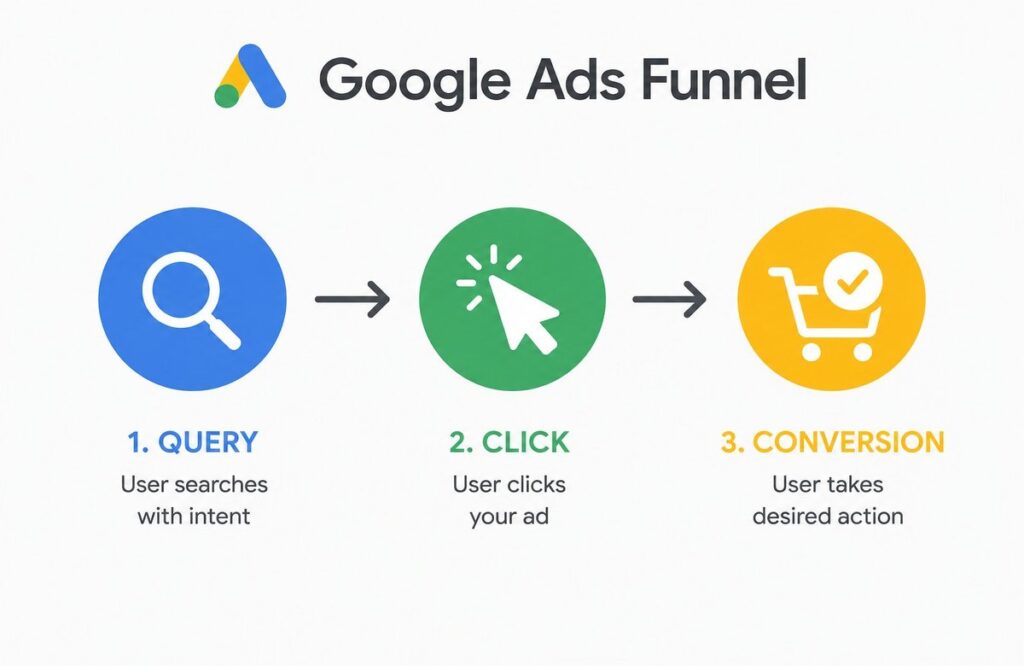
Think about the difference between someone scrolling Instagram and someone typing “emergency plumber near me” into Google at 11 pm.
The Instagram scroller is not looking for anything. They are killing time. Any ad they see is an interruption — something to swipe past. The person typing into Google at 11 pm has a burst pipe. They want help right now and they are calling whoever shows up first.
That gap in intent is why Google Ads work differently from every other paid advertising channel. You are not creating demand. You are capturing it. The person already wants what you offer. You just have to show up.
Google’s own Economic Impact data shows businesses average $2 in revenue for every $1 spent on Google Ads. That average includes a lot of badly managed accounts dragging it down. Well-run campaigns for service businesses regularly hit 3x to 6x ROAS when targeting, tracking, and landing pages are dialed in.
Here is what makes Google Ads genuinely powerful for small businesses:
- High-intent searches reach people ready to act — not people who might act someday
- Fast visibility means ads go live within hours and can produce leads the same week
- Budget control with daily spend limits and no minimums
- Local targeting focuses spend on the exact area a business actually serves
- Measurable results showing exactly which keywords and ads produce real leads
The platform works. The question is always whether the campaign is built to take advantage of it.
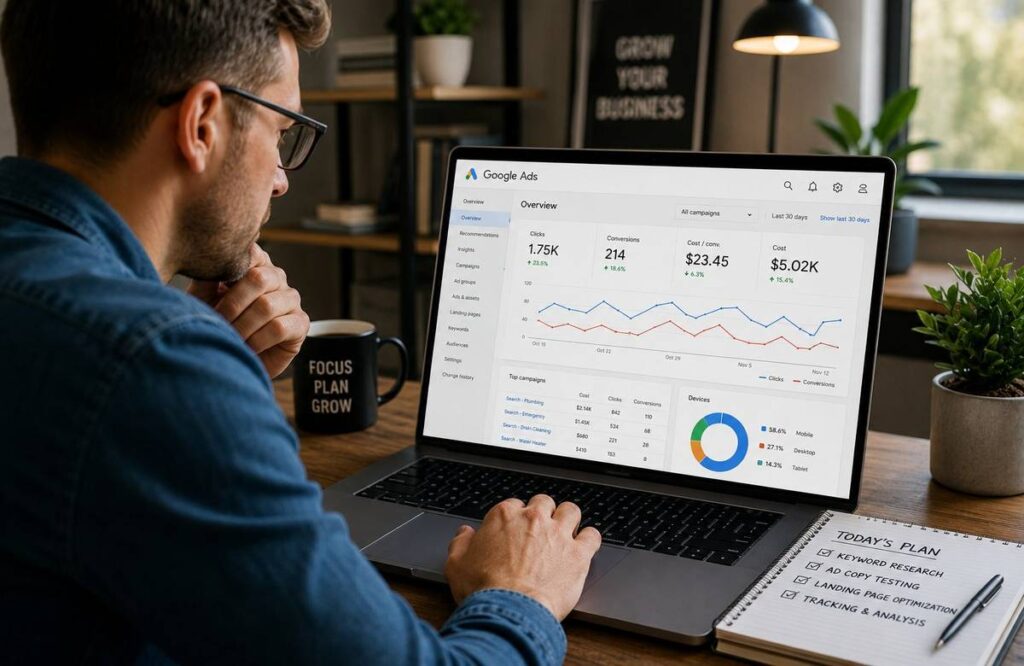
When Google Ads Work Best for Small Businesses
Some business types are structurally better fits for paid search. Understanding this before spending money matters.
Local Service Businesses
Plumbers, electricians, HVAC companies, locksmiths — these businesses get called when something breaks. The customer is not browsing leisurely. They have a problem and they want it fixed today. Do Google Ads work for small businesses in these categories? Consistently yes.
Emergency and Same-Day Services
Water damage restoration, emergency dental, roadside assistance, appliance repair — when the decision timeline is twenty minutes the person clicks the first credible result and calls. Conversion rates in these categories are among the highest in paid search.
Home Improvement and Renovation
Someone searching “kitchen remodeling contractor near me” is not researching for fun. They have a project and a budget. One closed job at $30,000 justifies weeks of ad spend.
Healthcare and Professional Services
Dentists, lawyers, med spas and financial advisors — compete hard on Google because lifetime client value is significant. A single new dental patient retained long-term is worth thousands of dollars.
E-commerce and B2B
Shopping Ads put product images directly in front of people searching for exactly what you sell. B2B service buyers use Google to evaluate vendors during the research stage — Google Ads captures them at that moment.
When Google Ads Do NOT Work
This section matters more than the rest of them put together.
No conversion tracking is the most expensive problem in small business Google Ads. Budget is spending. Clicks are happening. And there is no way of knowing whether a single one became a customer. Without tracking you cannot optimize anything. Fix this before spending a dollar.
Weak landing pages kill campaigns that would otherwise work. A homepage has fifteen things competing for attention. Someone who clicked your ad for “emergency roof repair” does not want to navigate your full website. One page. One message. One phone number. One button. That is what converts.
Budget too low for the market. A $5 daily budget in a legal or medical category where individual clicks cost $40 to $80 produces two clicks per day. You cannot learn anything from two clicks per day. Budget has to match competitive reality.
Broad match keywords without negatives will match ads to searches that have nothing to do with your business. A flooring company running broad match on “floors” might show up for “dance floors” or “floor lamps.” Every irrelevant click costs money and produces nothing.
Wrong location targeting bleeds budget fast. A local business showing ads statewide is paying for clicks from people it cannot serve. Get the radius right.
No follow-up system. Someone submits a form at 2 pm. Nobody calls until the next morning. That lead has already been booked a competitor. Speed to lead is critical — especially for service businesses where multiple competitors appear in the same search.
Auto-applying Google’s recommendations without reviewing them is how accounts quietly expand into expensive settings that benefit Google’s revenue more than yours.
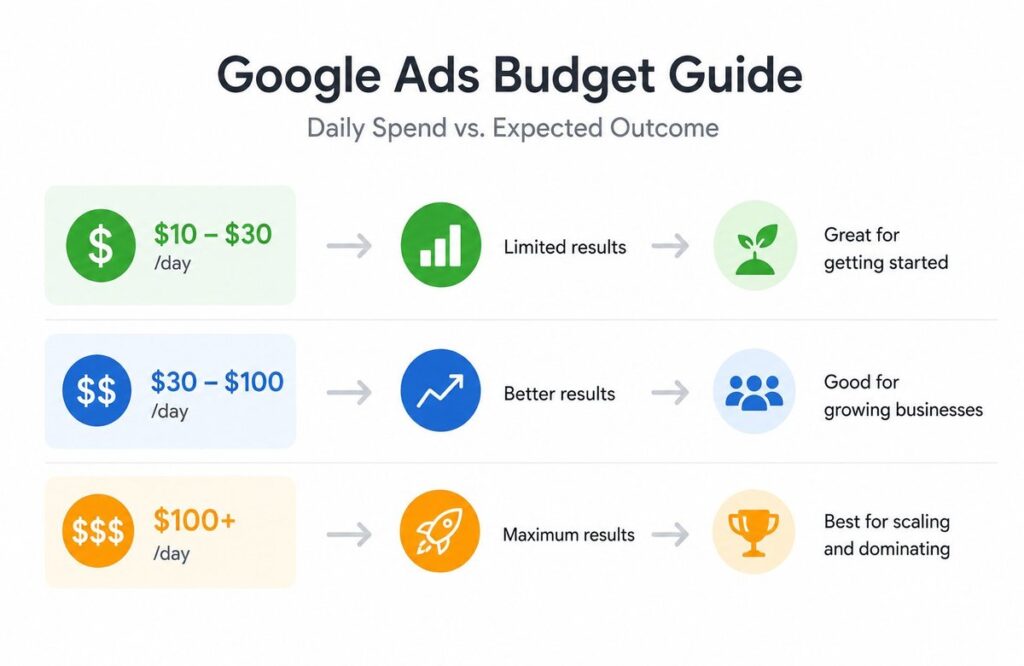
How Much Should a Small Business Spend on Google Ads
Budget is the first question every small business owner asks and it deserves a straight answer.
| Daily Budget | Best Use Case |
| $10/day | Basic testing only — very limited data |
| $30/day | Small local testing in low-competition markets |
| $50/day | Better lead data — enough to start optimizing |
| $100/day | Stronger optimization across multiple keywords |
| $1,000–$2,500/month | Realistic starting point for most small businesses |
The right number depends entirely on what clicks cost in your niche and location. A cleaning company in a mid-size city might pay $3 to $6 per click. A personal injury attorney in a major metro might pay $60 to $150 per click. Completely different conversations.
A practical rule — you need enough daily budget to generate at least 5 to 10 clicks per day. Below that the data is too thin to tell you anything. StubGroup’s research suggests most small businesses need $30 to $50 per day minimum to collect data worth acting on. For competitive categories $100 per day is where campaigns start producing consistent enough results to optimize against.
One thing most guides leave out. Management fees are separate from ad spend. Budget for both.
Best Google Ads Campaign Type for Small Business
Search Ads — Best Starting Point
Text ads triggered by specific searches. The intent is explicit. The person searched for something. Your ad matched it. Most predictable lead generation results for businesses new to paid search.
Local Services Ads — Best for Eligible Businesses
Appear above regular paid ads for qualifying categories — plumbers, electricians, HVAC, locksmiths, and others. Show your rating. You pay per lead not per click. For eligible businesses this is one of the best deals in Google advertising. Set this up first.
Shopping Ads — Best for E-commerce
Product images, prices, and store names directly in search results. For product-based businesses Shopping consistently outperforms text ads for product-specific searches because it matches how people actually shop.
Performance Max — Useful But Risky With Small Budgets
Runs across all Google surfaces using automation. Works well with strong conversion data and account history. With limited tracking and a small budget it burns through spending across channels that may not be relevant before it has enough data to correct itself.
Display Ads — Better for Remarketing
Works for showing ads to people who have already visited your site. For cold traffic from people who have never heard of your business Display typically underperforms Search significantly.
[Image 4: Campaign type comparison showing best use case and intent match for each format] Alt Text: best google ads campaign type for small business
How Long Does Google Ads Take to Work
| Time Period | What Actually Happens |
| First few days | Impressions and early clicks — very thin data |
| Week 1 to 2 | Initial keyword and ad signals emerge |
| Week 3 to 4 | Early lead patterns visible |
| Month 2 to 3 | Optimization becomes data-backed |
| After 90 days | Real performance baseline established |
The most common reason small businesses quit Google Ads early is expecting peak performance in week two. That is not how it works. Google’s smart bidding needs 30 to 50 conversions to optimize effectively. A business generating 15 leads per month needs two to three months before automated bidding even kicks in properly.
StubGroup recommends treating the first 60 to 90 days as a ramp-up period before making final ROI judgments. That is the right frame. Launch with realistic expectations. Optimize weekly. Judge at 90 days.
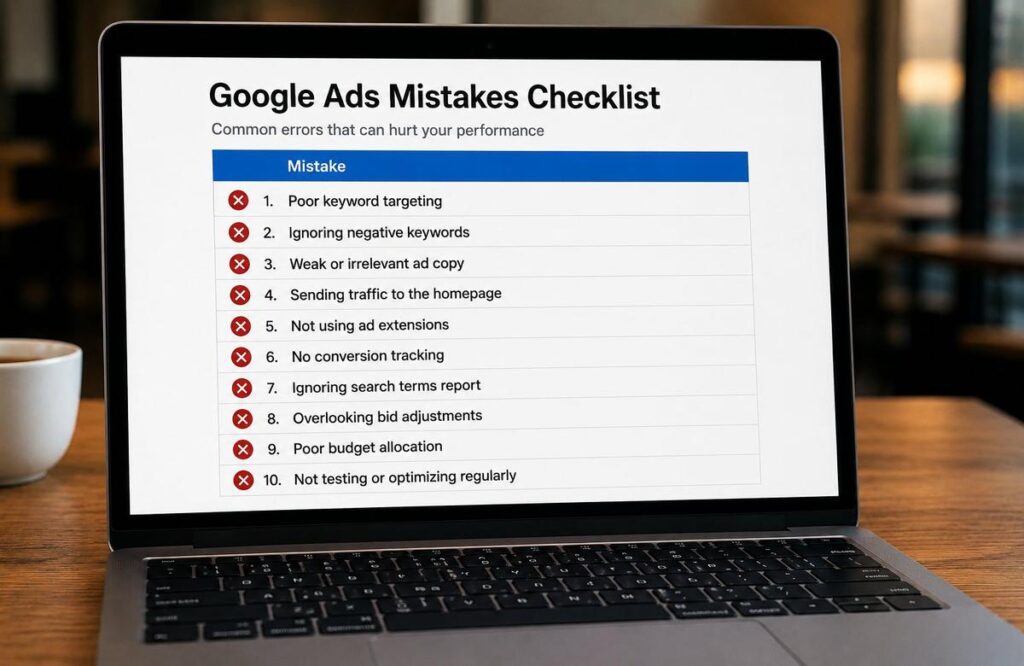
Common Google Ads Mistakes Small Businesses Make
These show up in nearly every account that comes to us for an audit. All of them are preventable.
Using broad match too early pulls irrelevant traffic before enough data exists to filter intelligently. Start with exact and phrase match.
No negative keywords from day one means paying for searches that will never convert. Build the list before launch. Review search terms every week.
No call tracking makes phone leads invisible. You see clicks and spend but cannot connect them to actual calls. Optimization on a major conversion source becomes completely blind.
Poor landing page experience — slow load, no headline above the fold, no visible phone number — wastes every dollar the ad spent getting someone there.
Targeting too wide spreads budget across areas the business cannot serve efficiently.
Running one campaign for all services makes smart budget allocation impossible. Each core service needs its own campaign.
Not checking search terms weekly lets irrelevant queries drain budget quietly over time. Fifteen minutes a week. Non-negotiable.
How to Make Google Ads Work Better
Start with buyer-intent keywords. Near me, hire, cost of, best — people using these are evaluating options and getting ready to act. Skip broad informational terms until conversion data justifies expanding.
Phrase and exact match first. These give you control. Broad match gives Google control. Start with control then expand with evidence.
Build the negative keyword list before launch. Think through what irrelevant searches your keywords could attract. Block them before they cost you anything.
One landing page per service. Match the headline to the ad. Fast, clear, focused on one action. The gap between ad message and the landing page message kills conversions.
Track every conversion point. Calls, form fills, booking confirmations, chat — every contact method needs a goal in Google Ads.
Write ad copy around the customer’s actual problem. They searched because something was wrong or needed doing. Acknowledge that. Add a specific reason to choose you. Clear action at the end.
Optimize every week without skipping. Search terms. Bid performance. Ad copy tests. Budget toward top performers. This weekly habit is what turns a mediocre campaign into a good one over 90 days.
Measure cost per lead not clicks. Clicks are a means to an end. The end is a lead at a cost that makes the math work.
Real Small Business Examples
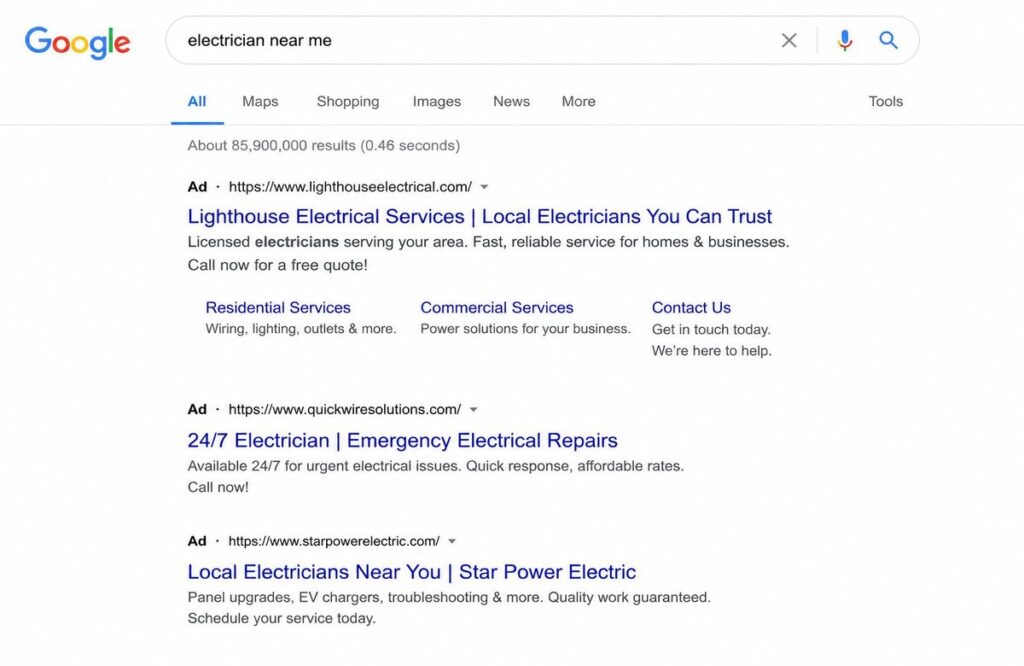
A plumber running “plumber near me” and “burst pipe repair” with call tracking and a dedicated landing page at $50 to $75 per day produces 8 to 15 qualified calls per week in a mid-size market. We cover the full setup in our Google Ads services for plumbers guide.
A dentist running “teeth whitening near me” and “dentist accepting new patients” tracks form submissions from the booking page to see exactly which keywords fill the schedule. One retained patient is worth thousands — the math works even at $80 to $100 per day.
A kitchen remodeling contractor using “kitchen remodeling contractor near me” attracts homeowners with real projects. A single closed job at $25,000 makes even expensive clicks look cheap.
An e-commerce outdoor gear store running Shopping Ads for specific product searches puts product images directly in front of buyers. ROAS of 4x to 8x is achievable in well-managed Shopping campaigns in less competitive categories.
A local marketing agency targeting “Google Ads agency near me” captures business owners actively searching for services. Our own Google Ads management services campaigns run on this exact model.
For industry-specific structures we cover Google Ads for auto repair shops and Google Ads for financial advisors separately — same principles, different search patterns.
Ready to Run Google Ads That Actually Work?
Most small business Google Ads campaigns fail because of setup problems — not platform problems. Our team has been building and managing profitable campaigns since 2019 across dozens of industries.
Get a free Google Ads strategy session from Ecommerce Planners — we review your business, your market, and your goals and show you exactly what a properly built campaign looks like for your specific situation.
Final Verdict
Do Google Ads work for small businesses? Yes. When the setup is right, the budget fits the market, conversion tracking is running, and someone optimizes every week — they work.
The businesses that fail are not failing because the platform is broken. Broad keywords. No tracking. Homepage traffic. Budgets are too thin. Timelines too short. Every one of those is a setup problem. Everything is fixable.
The businesses that win are not always the ones with the biggest budgets. They got the fundamentals right — buyer-intent keywords, dedicated landing pages, full conversion tracking, weekly optimization — and stayed consistent long enough for the data to compound into something predictable.
Google Ads rewards specificity and consistency above everything else. Get those two things right and the results follow.
Need help running profitable Google Ads for your small business? Contact Ecommerce Planners today for a custom Google Ads strategy built around your specific goals and budget.
According to WordStream’s 2025 marketing trends survey, 76% of small businesses report being satisfied with their search advertising tactics — and almost half of SMBs are planning to invest more in search advertising this year, confirming continued confidence in Google Ads among growth-focused small businesses
Source: WordStream
FAQs
Q1 How much should a small business spend on Google Ads?
Between $1,000 and $2,500 per month is realistic for most small businesses wanting meaningful data. Daily budgets of $30 to $50 work in low to mid-competition markets. Competitive categories like legal or medical require higher budgets to generate enough clicks to optimize.
Q2. Is $10 a day enough for Google Ads?
In most markets no. At $10 per day you might get two to four clicks — not enough to identify patterns or make useful optimization decisions. Works as a bare minimum test but should not be treated as a real campaign budget.
Q3. How long does Google Ads take to work?
Early lead patterns emerge around weeks three to four. A reliable baseline takes 60 to 90 days. Google’s smart bidding needs 30 to 50 conversions to optimize — judging a campaign at two weeks is almost always premature.
Q4. Are Google Ads better than Facebook Ads for small businesses?
For businesses where customers search when they need help — plumbers, dentists, contractors, lawyers — Google consistently outperforms Facebook because the intent is already there. Facebook builds awareness among people who might need you someday. Google captures people who need you right now.
Q5. What type of Google Ads campaign is best for small businesses?
Search Ads for most businesses because intent is explicit. Local Services Ads first if your category qualifies — you pay per lead not per click. Shopping Ads for e-commerce. Performance Max only when conversion tracking is solid and the account has real historical data.
Q6. Why do Google Ads fail for some small businesses?
No conversion tracking. Broad match without negative keywords. Weak landing pages. Budgets too small for the market. Wrong location targeting. Traffic sent to homepages. These failures are predictable and preventable — most appear in the first two weeks of a badly set up campaign.
Q7. Should small businesses hire a Google Ads agency?
For businesses spending $1,500 or more monthly on ads yes. Professional management typically pays for itself through reduced wasted spend and better conversion rates. The learning curve is steep and mistakes during that curve are expensive. A qualified agency eliminates those costs while producing results faster.

